Yes. A SEBI-registered adviser or AMFI-registered distributor can be recommended by ChatGPT, Gemini, Claude and Grok without breaking the rules. SEBI’s advertising code bars superlatives, guaranteed returns and past-performance claims. It doesn’t stop a plain, factual website from being read and quoted, and that’s the part most advisers miss completely.
This guide covers what the adviser code and AMFI’s rules allow, what AI tools check on a financial practice’s website, and how to test your visibility each month without wording a compliance officer would flag.
Can an AI tool recommend a financial adviser at all?
Yes. A client in Thane types, “Who’s a fee-only financial planner near Navi Mumbai station who can help with retirement?” The tool reads the pages it finds and names the advisers whose pages describe them clearly. Our guide on how AI tools decide which business to recommend covers the mechanics, so this one stays with what matters for advisers.
Compliance changes what your pages can say. It doesn’t remove the pages. A page that says who you serve, how you’re registered and how you charge is both compliant and easy to quote. The pages that get skipped are the vague ones full of adjectives, and those are also the ones most likely to drift into claims the code bars.

What does SEBI allow an investment adviser to say in an ad?
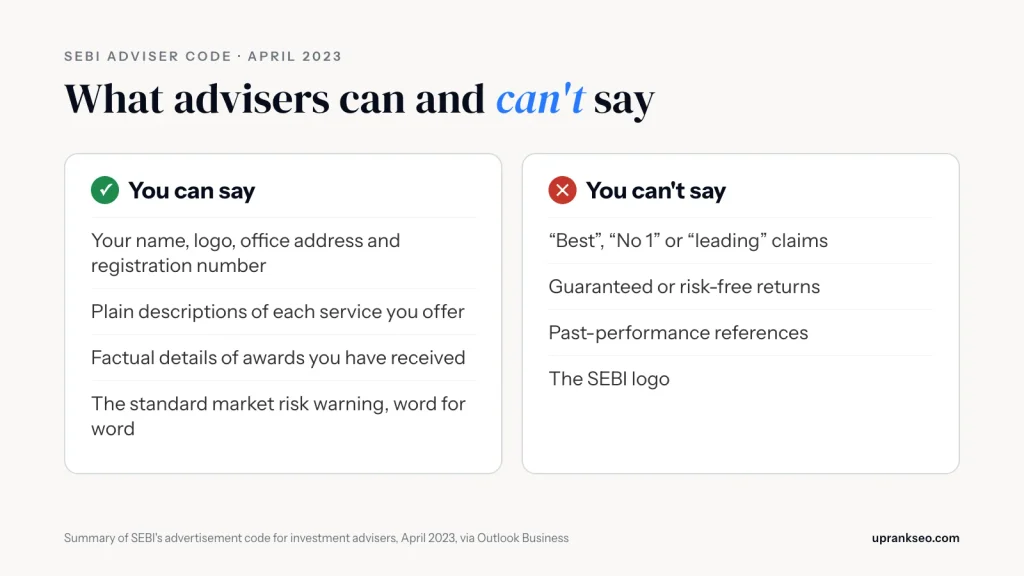
The current rules for investment advisers come from SEBI’s advertisement code for investment advisers and research analysts, set out in a circular dated 5 April 2023. SEBI’s circular page gives the number and date, and Outlook Business’s summary sets out the rules. In short, an ad can’t use superlatives such as “best”, “No 1” or “leading”. It can’t promise or guarantee risk-free returns, refer to past performance, or use the SEBI logo.
Every ad must carry your name, logo, office address and registration number, plus the standard market risk warning. The wording of that warning can’t be changed. Investment advisers also need approval from BSE Administration and Supervision Ltd, a SEBI-recognised supervisory body, before an ad goes out, and copies of every ad must be kept for five years. Factual details of an award you’ve received may be included.
Those are the points we could confirm from the circular and its summary. Your compliance officer should read the current text before you publish anything new.
What changes if you sell mutual funds?
If you’re an AMFI-registered distributor, AMFI’s guidelines apply to your posts as well. In December 2025, AMFI told distributors not to publish “any advertisements or posts without following the prescribed AMFI guidelines”, after some of them ran newspaper ads that didn’t follow those guidelines. AMFI’s direction, as reported by CafeMutual says communications must be clear, carry disclaimers and avoid misleading statements. They must not include performance projections or assurances of returns, and they must not offer investors incentives.
From 1 May 2026, AMFI also expects distributors to show their name and registration number across social media profiles and posts, websites, business cards and email signatures. The standard wording is “AMFI Registered Mutual Fund Distributor (ARN)”. AMFI says non-compliance may result in suitable action, and AMCs and AMFI will check it during distributor due diligence.
Many advisers hold both roles. An RIA and an MFD answer to different rulebooks, so label each post with the right registration and don’t mix the two into one claim.
What should your website say, in plain words?
AI tools check the same handful of things on every practice they read. Here’s what each one looks for, and a compliant way to answer it.
| What the AI checks | What to publish |
|---|---|
| Do you offer the service the client asked about? | A separate page for each service, such as retirement planning, SIP reviews or tax planning, saying who it’s for |
| How do you charge? | Your fee model in plain words, and what the fee covers |
| Who gives the advice? | Each adviser’s name, qualifications and registration number |
| Are you where the client is? | The same name, office address and phone number on your site, Google and directories |
| What do other people say about you? | Mentions in news, association pages and listings you don’t control |
| Can the tools read it? | Key facts as text, not inside images or PDFs |
Slogans add nothing here. “Wealth partners you can trust” gives an AI nothing to repeat. “Fee-only retirement planning for salaried families in Thane, with the fee explained on the page” does.
Google says its AI features need no extras. It states there are “no additional requirements to appear in AI Overviews or AI Mode, nor other special optimizations necessary”, and that there’s no special schema.org structured data you need to add. Clear pages do the work.
For listings, Google’s guidance is direct: . For a practice, that’s a local SEO job. Fill in your categories, services and hours, and make the “businesses with complete and accurate info are more likely to show up in local search results”egistration details identical everywhere they appear.
Does Google matter as much as ChatGPT?
Google’s AI features sit on top of normal search. Google says a page must be “indexed and eligible to be shown in Google Search with a snippet” to be used, so solid AI SEO covers most of what Google needs.
ChatGPT works differently. OpenAI says its OAI-SearchBot “is used to surface websites in search results in ChatGPT’s search features”, and that sites opted out of it “will not be shown in ChatGPT search answers”. It also says robots.txt changes take about 24 hours to apply. So check that your robots.txt isn’t blocking Googlebot or OAI-SearchBot, and consider adding your site to Bing Webmaster Tools too.
Do the AI tools agree with each other?
Often not. In an October 2026 field test by Ryan Doser, four AI assistants, including ChatGPT, Gemini and Claude, were asked local questions in Omaha and Boise. Their first picks matched in 6 of 72 head-to-head comparisons, about 8%. Only 22.8% of their suggestions were in Google’s top three map results. When 12 of the 48 answers were rerun, about 79% of the businesses came back.
Those were home-service questions in two US cities, and the sample is small, so treat it as a direction rather than a verdict. The point still holds for advisers: don’t optimise for one tool.
How do you check whether AI recommends you?
Test once a month. Open ChatGPT, Gemini, Claude and Grok in fresh chats and ask the questions your clients ask:
- “Who is a SEBI-registered investment adviser in Thane for retirement planning?”
- “Which fee-only financial planner near Navi Mumbai explains how they charge?”
- “Which mutual fund distributor in Mumbai helps a salaried couple start SIPs?”
- “Who in Kalyan does tax planning for a salaried family?”
Note whether you’re named, which pages each tool cites and which competitors appear. Those cited pages show where to get listed next. Don’t copy a sentence from an AI answer into your own marketing without checking it against the code first.
Frequently asked questions
Can a SEBI-registered adviser post on social media? Yes. Treat every post as an advertisement, with no superlatives and no return promises, and with your registration number and the standard risk warning on it.
Can I ask clients for Google reviews? The sources we read don’t spell out how reviews apply to advisers, so we can’t give you a clear yes. The risk is a review that mentions returns or performance. Check with your compliance officer before you ask, and never ask a client to write about returns.
Do I need special schema markup for AI tools? No. Google says there’s no special schema.org structured data you need to add for its AI features. Clear pages, matching listings and open access for crawlers matter far more.
Will ChatGPT show my firm if I block its crawler? No. OpenAI says sites opted out of OAI-SearchBot will not be shown in ChatGPT search answers. Check your robots.txt, and allow both Googlebot and OAI-SearchBot unless you have a deliberate reason to block them.
Has SEBI’s new common advertisement code taken effect? SEBI’s board approved a Common Advertisement Code on 24 September 2026. Lakshmikumaran and Sridharan read it as replacing the existing codes only once it’s notified. Until then, the 2023 adviser code is the one to check. The draft also changes the approval process, so read the notification closely when it arrives.
How long before AI tools start naming my firm? OpenAI says robots.txt changes reach its search systems in about 24 hours. Rankings and listings take longer to move, so track them monthly rather than expecting a quick win.
Find out what AI says about your practice
We’ll ask ChatGPT, Gemini, Claude and Grok the questions your clients ask, show you who gets named, and flag any wording a compliance officer should look at. It’s free. Request your AI visibility check.