Your Instagram grid proves you do good work. But ChatGPT, Gemini, Claude and Grok mostly answer from web pages and listings they can read, and a grid of photos with “loved it!” under each one gives them little to work with. To get named, turn that proof into plain text: name the service and area, and put genuine reviews where search can find them.
Instagram still matters, because it’s often where a client first sees your work. This guide shows how to carry that work over to the places AI tools read, for a salon in Thane, Navi Mumbai, Kalyan or Mumbai, and what to leave out so your posts don’t cause problems of their own.
Why doesn’t a strong Instagram feed get a salon named?
Picture a woman in Kalyan who saw a balayage she liked on a salon’s feed. A week later she types into an AI assistant, “Which salon in Kalyan does balayage and shows real client work?” The tool doesn’t scroll Instagram the way she does. It runs a search, opens a handful of pages it can read and names the salons those pages describe clearly.
Instagram is a hard place for that process to read. Its robots.txt file tells crawlers in general to stay off the whole site, and OpenAI’s search crawler, OAI-SearchBot, falls under that general rule. OpenAI says the crawler “is used to surface websites in search results in ChatGPT’s search features”. A post that exists only on Instagram is a weak source for an AI answer.

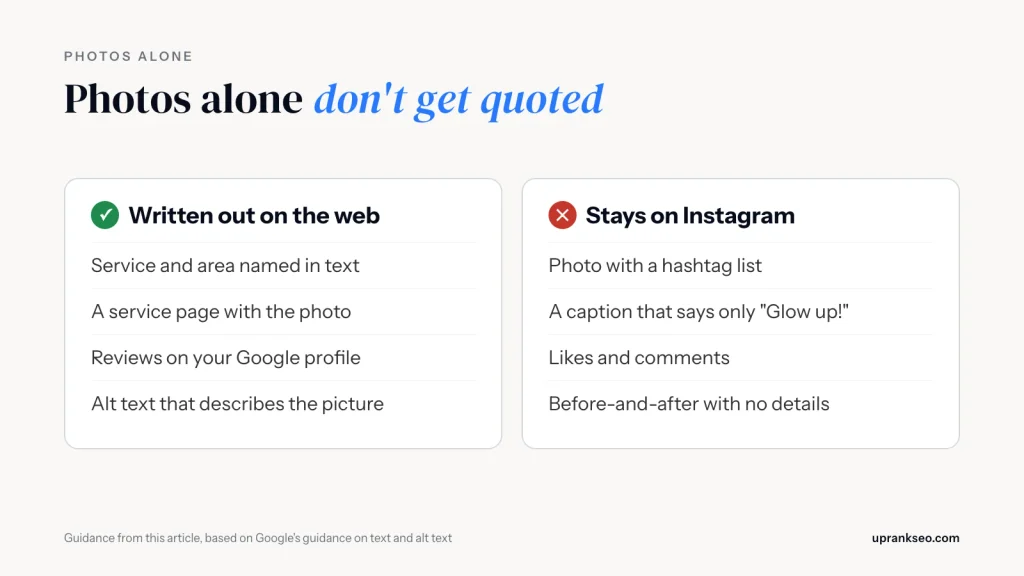
That doesn’t make your posts worthless. Clients still see them, search your name and walk in. The trouble is that an AI answer is built from what it can read, and Google says much the same about its own AI features. Its guidance is that important content should be “available in textual form”. So the work you show in photos needs to appear in words somewhere else as well.
Where do AI tools look for a salon?
They look at the places that describe you in text. Our guide on how AI tools decide which business to recommend explains the mechanics. For a salon, the places that matter are these, and each one should tell the same story.
| Place | What an AI tool can read there | What to put in it |
|---|---|---|
| Your website | Service pages, prices and written-out results | One page per main treatment, with a few of your best photos and two plain lines of description |
| Google Business Profile | Categories, services, photos and reviews | Accurate categories, your best work photos and the same service names as your website |
| Google reviews | Star rating, review text and your replies | Genuine reviews from clients, each one answered |
| Directories and local mentions | Name, address, phone and what you offer | The same details as your website on Justdial, Sulekha and local listings |
| Captions and photos, though AI crawlers often can’t reach it | Captions that name the service and area, to back up the text elsewhere |
Google’s help page on local ranking puts the basic rule plainly: “businesses with complete and accurate info are more likely to show up in local search results”. Accurate means the same services, the same area and the same phone number in every row above. If you’d rather have someone handle the listings, our local SEO service covers them, and our AI SEO service covers the wider work.
How do you turn one Instagram post into text?
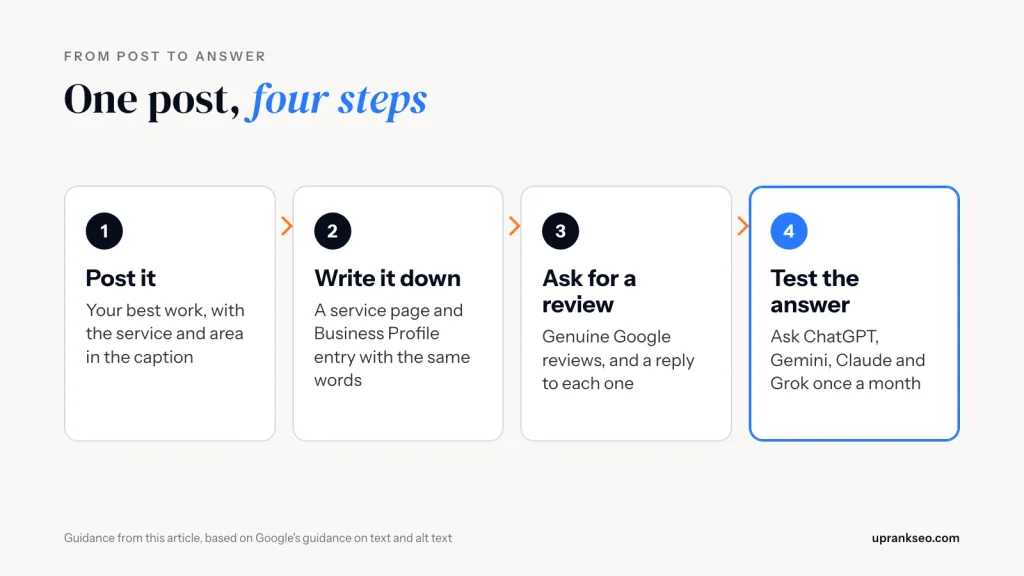
Start with the five or ten posts that show your strongest work, then do these steps for each one. Once you have the rhythm, most take a few minutes.
- Name the service and the area in the caption. “Balayage on shoulder-length hair, Kalyan West, with a toner and blow-dry” tells a reader and an AI tool far more than “Glow up!” with a list of hashtags.
- Carry the same words onto a service page. Write two plain lines on what the treatment is and who it suits, then add the photo. The post is for the client scrolling past. The page is what a crawler can read.
- Write alt text for every photo. Google says that the “most important attribute when it comes to providing more metadata for an image” is the alt text. Describe what the picture shows, such as “Woman with long brown hair after a balayage, seen from behind in a salon chair.” Google also advises that “Avoid filling alt attributes with keywords”, so write it for a reader, not a search box.
- Match your Business Profile. Use the same service names as your website, and upload your best work there too. Google says you can “show customers what you offer and tell the story of your business with photos and videos”.
- Back up any result you claim. If a caption promises a result, the service page should say what that result depends on, so the promise and the page match.
Hashtags deserve a word. They help people browse a topic, but they don’t name a service the way a sentence does, so don’t rely on them to tell an AI what you offer.
Should you embed your Instagram feed on your website?
An embedded feed looks lively, and there’s nothing wrong with having one. Treat it as decoration, though. The facts that matter, such as the treatment, the area, the price range and the result you can show, should sit in the page text. If a fact appears only inside an embed or a picture, an AI tool has nothing to read.
Do Instagram comments count as reviews?
Not in the way Google counts them. Reviews on your Google Business Profile feed your listing, and Google says that “more reviews and positive ratings can help your business’s local ranking”. A comment that says “stunning colour!” under a post is pleasant to read, but it doesn’t sit in your listing.
So ask clients who are happy with their result to leave a Google review. Make it easy with a short link on the bill or a card at the desk, and reply to every review in plain words, good or bad. Ask steadily rather than in one burst. Never pay for reviews, never write them yourself and don’t offer a discount in return for five stars. Those are the fastest ways to lose the trust reviews are meant to earn.
Which client work can you show?
Client photos are the best proof a salon has, and they’re also where most trouble starts. Before-and-after shots, client quotes and claimed results all fall under the rules on advertising and endorsements.
The CCPA’s guidelines on misleading advertisements and endorsements say an endorsement must reflect the “genuine and reasonably current opinion of the endorser”. In plain terms, a quote from a client who had the treatment and means it is fine. A quote you wrote and attributed to a client isn’t. A law firm’s summary of the guidelines puts the penalty at ₹10 lakh for a first offence and up to ₹50 lakh for later ones.
The advertising industry’s self-regulatory ASCI Code expects advertisers to be able to back up claims of objectively ascertainable fact. So “the best balayage in Kalyan” needs proof, and a result shown in a photo has to be the real result. In practice:
- Ask before you post a client’s photo or quote, and keep a note of the yes.
- Show the result as it looked in the chair, not edited to look better.
- For before-and-after shots, use the same light and angle, and say how long the change took.
- If a client gets a free treatment in return for a post, this may count as paid promotion, so say so in the post. Check the wording with a legal adviser.
These are rules for what your salon publishes. They’re written for advertisers, so read them as guidance for your own marketing rather than legal advice.
How do you check whether AI recommends your salon?
Test it once a month. Open ChatGPT, Gemini, Claude and Grok in fresh chats and ask the questions your clients ask:
- “Which salon in Kalyan does balayage and shows real client work?”
- “Who does keratin in Navi Mumbai, and what do clients say about frizz?”
- “Which salon in Thane takes walk-ins for beard trims?”
- “Where can I get a bridal hair trial in Thane West?”
Note whether your salon is named, what work the answer mentions and which pages each tool cites. If a tool names a salon for work you also post, look at the page it cites. That tells you what your own page is missing.
Frequently asked questions
Can AI tools read my Instagram captions? Not reliably. Instagram’s robots.txt tells crawlers in general to stay off the site, and OpenAI’s search crawler falls under that rule. Put the service, area and results in text on your website and Business Profile as well.
Should I stop posting on Instagram? No. Clients still find salons there and book from what they see. Just make sure each post’s service and area also appear on a page or listing that AI tools can read.
Should I post before-and-after photos? Only if they’re real, taken the same way and not edited to flatter. Get the client’s permission first and say how long the change took.
Do Google reviews matter more than Instagram likes? For search and AI answers, yes. Google says more reviews and positive ratings can help local ranking, and reviews sit on the profile that local results use. Likes don’t feed your listing.
Can I ask a happy client to post about my salon? Yes, but if you give a free treatment or a discount in return, the post may count as paid promotion, so say so in the post. Check the wording with a legal adviser, and never script what the client says.
How often should I check the AI answers? Once a month is enough for most salons. Answers change between chats, so one test proves little. Ask several questions in each of the four tools and compare the pages they cite.
Find out what AI says about your salon
We’ll ask ChatGPT, Gemini, Claude and Grok the questions your clients ask, show you which salons get named, and point to the posts that still need words behind them. It’s free. Request your AI visibility check.