

An NRI in Dubai or London who wants an adviser in India will often ask ChatGPT, Gemini, Claude or Grok first. The tool reads what’s published and names the advisers whose pages explain their registration, fees and how they work from abroad. To get named, your practice has to be easy to check from another time zone, and it has to stay within SEBI’s rules.
This guide is for SEBI-registered advisers in India who already have NRI clients, or want more. It covers how these clients search, why residency matters, what the advertising rules limit and what your pages should publish.
Why do NRIs ask an AI tool before they call?
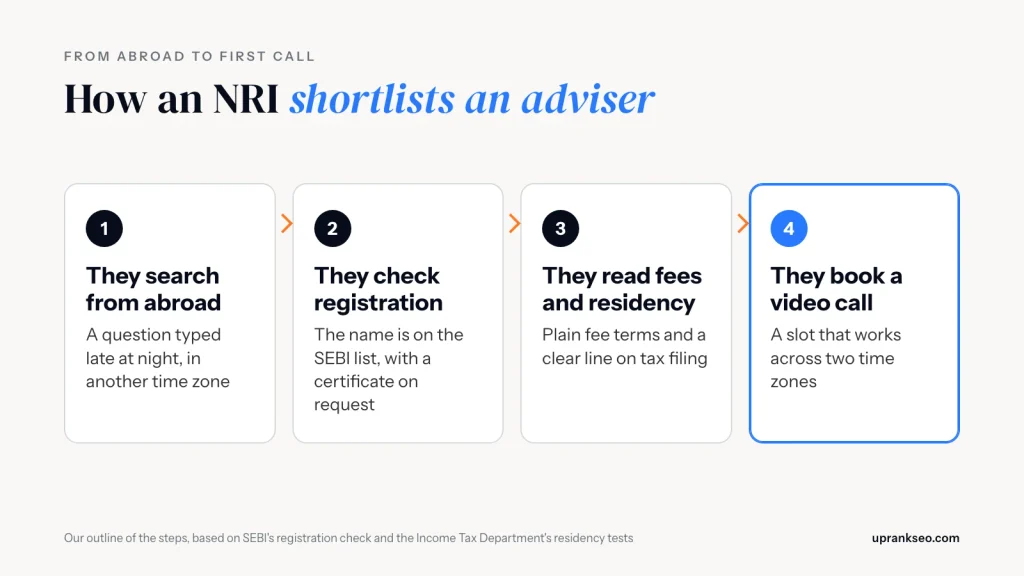
An NRI is usually far from your office. They might be in Singapore, Toronto or Muscat, with parents in Thane, a flat in Navi Mumbai they rent out, or a salary they want to put to work. They can’t walk in, so they type a question at 11 at night their time and expect a clear answer by morning.
A typical question sounds like “Which fee-only financial adviser in Thane handles NRI investments and tax filing?” The tool doesn’t know you personally. It reads what’s published about you, and then it decides whether your pages are clear enough to name. Our guide on how AI tools decide which business to recommend walks through those steps, and our AI SEO service covers the technical side. For advisers the steps are the same, with more limits on what you can say.

Does residency change which adviser an NRI needs?
Yes, and a good adviser asks about it in the first call. Under the Income Tax Department’s rules, an individual is resident in India for a tax year if they stay 182 days or more in that year. They are also resident if they stay 60 days or more in that year and 365 days or more across the four years before. The Department’s non-resident guidance says the current Income Tax Act keeps these same two tests.
Visiting citizens and persons of Indian origin face a different test. For those earning over ₹15 lakh a year from sources other than foreign sources, the 60-day limit becomes 120 days, alongside 365 days across the four years before. Two people who look alike on paper can end up with different answers. The same page is clear that tax residency is a separate question from the FEMA term “person resident outside India”, so your advice should separate the two.
Your page can’t decide an NRI’s status for them. It can say that residency is the first question you ask, that you’ll check it before any advice, and that a chartered accountant confirms the filing. That single line tells a careful reader you know the work.
What can an adviser say to NRI clients under SEBI’s rules?
SEBI’s advertising code for investment advisers is the rulebook for adviser ads. As Outlook Business reported when the code was issued, ads should not promise assured returns, should not refer to past performance, and should avoid superlatives such as “best”, “No 1” or “top adviser”. The ad should carry the adviser’s name, logo, office address and registration number.
The rules are being updated. SEBI’s Board has recently approved a common advertisement code. Lakshmikumaran and Sridharan’s analysis says it is set to replace the adviser code, and that it keeps the ban on guaranteed or assured returns and on misleading past-performance claims. We couldn’t confirm from that analysis when the new code starts to apply to advisers, or whether every superlative rule carries over. Ask your compliance adviser before you change a page.
Whatever the code says, NRIs check registration before they pay. Outlook Money’s guide explains that SEBI keeps a current list of registered advisers, and that a genuine adviser should be able to produce a registration certificate when asked. Put your registration number on the home page, the fee page and your Google Business Profile, so the check takes a few seconds.
What should an NRI-focused page publish?
Most advisers have one general page about “wealth management”. That tells an AI tool very little about who you serve or how the work runs from abroad. Build a page, or a clear section, that answers the questions an NRI actually asks.
| What the NRI checks | What your site should show |
|---|---|
| Is the adviser SEBI registered? | Name, registration number and office address on the site and every profile |
| How do you charge? | The fee basis in plain text, and whether you earn any commission |
| Can you work from abroad? | Video call times that work across time zones, and how documents are shared |
| Who files my tax? | A plain line on what you advise on, and when a chartered accountant takes over |
| What do clients say? | Reviews a reader can verify on Google, handled within your compliance rules |
Notice what’s missing from that table: “best adviser for NRIs” and any promise of returns. A fee basis or a call window gives an AI tool something concrete to quote, which “best adviser” does not.
Account type is one of the first things an NRI raises. Some hold an NRE account, some an NRO account, and some both. Say on your page which account types you work with, and list the documents you ask for before the first call, so the client knows what to gather and the call can start with the plan.
If you also serve clients in Thane or Navi Mumbai, the listing rules are the same as for any local firm. The local SEO service covers them. Our wider guide, how to get AI tools to recommend your financial adviser practice, covers the rest of the compliance checklist.
What does cross-border search look like in practice?
Our closest case study isn’t a financial adviser. It’s a produce exporter in Thane that sells to the USA. The problem was the same: get a business named by people sitting in another country. Its AI assistant referrals went from 0 to 43 a month, and 9 of its 14 US keywords reached the top three on Google.
Read those two numbers separately. The AI referral figure is the one that matters for this guide. The top-three figure is a Google result, so treat it as search visibility rather than AI visibility. We don’t yet have a financial adviser case study to put beside it, and we won’t stretch this one to fit.
How do you check whether AI recommends your practice?
Test it once a month. Open ChatGPT, Gemini, Claude and Grok in fresh chats and ask what an NRI would ask:
- “Which SEBI-registered adviser in Thane works with NRIs in the US?”
- “Who can help an NRI in Dubai with investments and tax filing in India?”
- “Is there a fee-only financial planner in Mumbai who does video calls for NRIs in London?”
- “Which adviser in Navi Mumbai explains NRE and NRO accounts for someone returning to India?”
Write down whether your practice is named, where it appears and which pages each tool cites. Those cited pages show where your detail is thin, and where a listing or mention would help most.
Frequently asked questions
Can an NRI check an adviser’s registration from abroad? Yes. SEBI keeps a current list of registered investment advisers, and an adviser should be able to show a registration certificate on request. If the name isn’t on the list, don’t send money until you’ve checked again.
Does an adviser need to know my residency status? Yes. Whether you’re resident for tax purposes changes which rules apply to your income. An adviser can raise the question, but a chartered accountant should confirm your status and file the return.
Can an adviser promise NRI clients a fixed return? No. The advertising rules bar promises of assured returns, and the new common code keeps that ban. An adviser can describe a strategy and its risks, but not a guaranteed result.
Do I need a separate page for NRI clients? It helps a great deal. A page that covers how you work from abroad, which documents you need and how residency affects the work gives AI tools something specific to read.
Can a small practice beat a large firm in AI answers for NRIs? It can, because a detailed page gives the tool something to quote that a thin brand page doesn’t. A practice that explains who it serves and how it works has a real chance of being named.
How long before AI tools start naming us? There’s no fixed timeline, and anyone who promises one is guessing. Your pages have to be indexed and ranking first, and the tools then need time to pick them up.
Find out what AI says to your NRI clients
We’ll ask ChatGPT, Gemini, Claude and Grok the questions NRIs ask about Indian advisers, show you who gets named, and list the fixes to make, which your own compliance adviser should check. It’s free. Request your AI visibility check.