

When someone asks ChatGPT, Gemini, Claude or Grok for a salon near Vashi station, the answer comes from pages about that place, not from your brand’s homepage. So a chain or franchise gets named when each branch has its own clear listing, page and reviews. A well-known name helps, but it doesn’t put your Kalyan branch into an answer about Kalyan.
This guide is for salon chains, franchise networks and multi-branch parlours in Mumbai, Navi Mumbai, Thane and Kalyan. If you run a single salon, start with our guide for salons and parlours. Here we cover how to make each branch distinct, and what to avoid so you don’t end up with a pile of near-identical pages.
Why does an AI tool name one branch and skip the others?
Take a customer in Navi Mumbai who types, “Which salon near Vashi station does keratin with a cut included?” The tool isn’t looking for your company name. It’s looking for a place whose pages match keratin, cut and Vashi. A homepage that says “serving Mumbai and beyond” gives it nothing to match.
AI tools search the web for local questions and read the pages that describe a specific place clearly. Our guide on how AI tools decide which business to recommend covers the mechanics. For a chain, the key point is that every branch is a separate place to the tool. If your branches appear only as a list on the brand page, there’s very little for the tool to read about any one of them.
Does every outlet need its own Google Business Profile?
Usually, yes. Google’s guidelines say you should not create more than one page for each location of your business, whether in one account or several. They also say that a business with separate locations, each with its own staff and service area, is allowed one profile for each location. A salon branch with its own team and its own walk-in customers fits that description.
Google also asks you to maintain consistent names and categories across all your locations. So keep the brand name and category the same everywhere, but let each profile carry its own address, phone, hours, photos and services. Check your franchise agreement before you change anything, because it may say who controls each listing.
What should each outlet page show?
Each branch needs a page that covers what that branch actually offers. The table below is a working checklist.
| What the AI checks | What the branch page needs |
|---|---|
| Where the branch is | Full address with the nearest station or landmark, such as “near Thane station, east side” |
| How to reach it | The same phone number and timings as its Google profile |
| What it does there | Only the services that branch offers, not the whole brochure |
| Who does the work | Named stylists at that branch, with their specialities |
| What it costs | “Starts at” prices in ₹, with what’s included |
| What customers say | Recent reviews for that branch, and your replies |
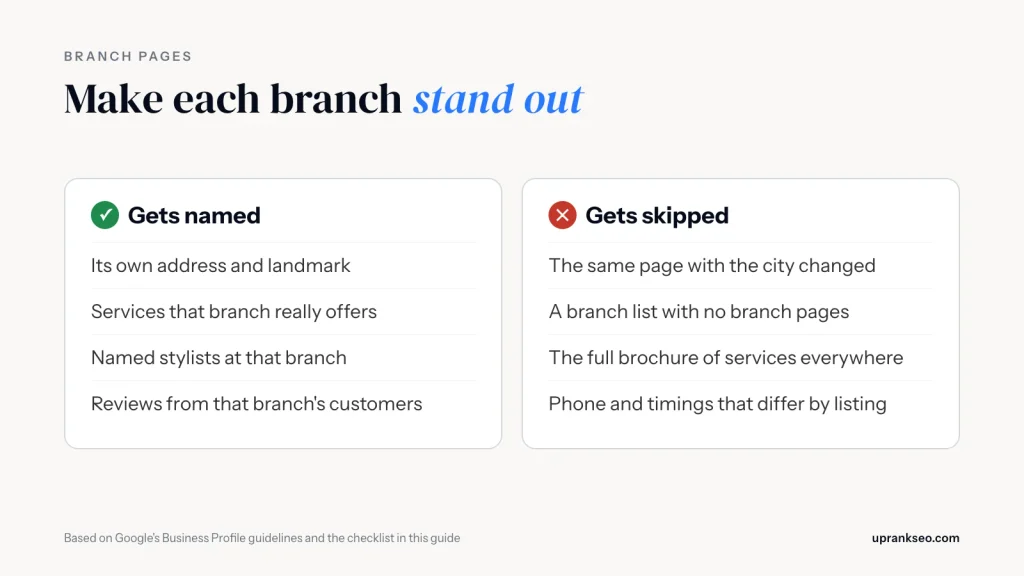
Don’t copy the Thane page to Kalyan and swap the city name. A tool reading two near-identical pages has no reason to choose one over the other, and your team ends up maintaining a dozen copies of the same text. Write one honest page per branch, even if some of them are shorter than the rest.
How do you collect reviews for each branch?
Google says that “more reviews and positive ratings can help your business’s local ranking”. For a chain, reviews sit on the profile they were left on, so reviews for the Kalyan branch help Kalyan and nobody else. Make it easy for customers to review the branch they just visited. A small card at the billing counter with that branch’s review link works well.
Reply to each review under that branch’s profile, and keep the replies short and specific. Never buy reviews, offer discounts in exchange for them, or ask staff to write them. Customers read reviews, and a batch of suspiciously similar ones makes a branch look worse, not better.
What do multi-city results look like?
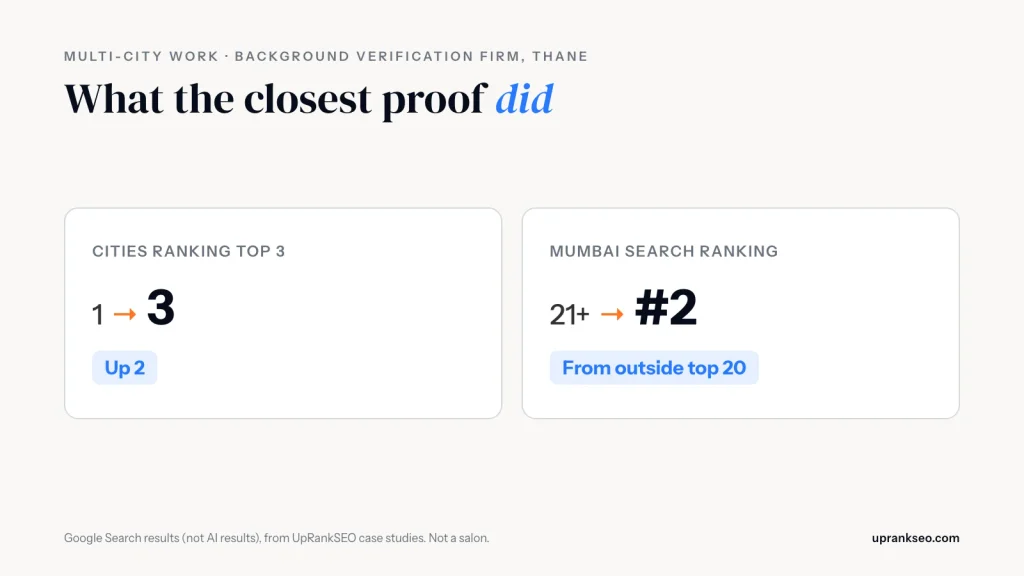
The closest proof we have for this kind of work is a case study for a background verification firm based in Thane. It isn’t a salon, but the job was the same: location pages for several cities, a page for each service, and regular Google Business Profile posts. Over a few months, the firm went from ranking in the top 3 in one city to the top 3 in three: Mumbai, Navi Mumbai and Thane. Its Mumbai search ranking moved from outside the top 20 to second place.
Read those figures with care. They’re Google Search results, not AI answers. Search rankings matter here because AI tools read the pages that rank well, but a better ranking doesn’t guarantee an AI mention. The full detail is on the case study page, and our multi-city SEO service sets up the same kind of location pages.
Can AI tools reach every branch page?
Not if you block them. OpenAI says its OAI-SearchBot “is used to surface websites in search results in ChatGPT’s search features”, and sites opted out of it “will not be shown in ChatGPT search answers”. It can take about 24 hours for its systems to adjust after a robots.txt change. So check the robots.txt file for every site your branches live on, including any branch subdomain.
Google says its AI features need no additional requirements or special optimisations, though a page must still be indexed and eligible to be shown in Google Search with a snippet. For the technical side of this, our AI SEO service covers what we check on a site.
Which mistakes make a chain disappear?
- A branch locator page with no branch pages behind it.
- Branch pages that differ only by the city name.
- Closed or moved branches that are still listed on Google, Justdial or Instagram.
- Different phone numbers or timings on different listings.
- Robots.txt rules that block a branch site or subfolder.
Each of these gives the tool a reason to doubt a branch, or nothing to read about it at all.
How do you check whether AI recommends each branch?
Test each branch, not just the brand. Pick one realistic question per branch and ask it in ChatGPT, Gemini, Claude and Grok, in a fresh chat each time:
- “Which salon near Vashi station does keratin with a cut included?”
- “Is there a bridal makeup studio in Kalyan that offers a trial session?”
- “Which unisex salon in Naupada is open on Sunday?”
- “Where in Bandra West can I get a hair spa at home, with the price told in advance?”
Write down which branch gets named and which pages each tool cites. Those cited pages show you where the gaps are. Don’t expect steady answers. In a US field test by Ryan Doser, the four assistants never all picked the same business first. They agreed on the top pick in only 6 of 72 head-to-head comparisons, and just 22.8% of their recommendations sat in Google’s top three map results. When the same questions were run again, about 79% of the businesses came back. So test every branch every month, and treat any single answer as a snapshot.
Frequently asked questions
Should a franchise outlet have its own Google Business Profile? Usually yes, if the outlet has its own staff and walk-in customers. Google’s guidelines allow one profile per location in that case, with consistent names and categories across the network. Check your franchise agreement first, since it may say who controls each listing.
Can one brand page get the whole chain named? Rarely for local questions. The brand page helps AI tools understand the company, but a question about one area is usually answered from pages about that area. Give every branch its own page and link to each one from a clear branch list.
Does ChatGPT read every branch page? Only if its crawler can reach it. OpenAI says sites opted out of OAI-SearchBot won’t appear in ChatGPT search answers, and robots.txt changes can take about 24 hours to apply. Check every branch site and subfolder.
Do chains need a separate AI strategy? Mostly not. Google says its AI features need no special optimisations, so the work is solid local SEO for each branch, done consistently. Clear, checkable pages help ChatGPT, Gemini, Claude and Grok alike.
How many reviews does a branch need? There’s no magic number. Aim for a steady flow of specific reviews for each branch, and reply to every one. Recent reviews that mention the services a branch offers say more to an AI tool than a large total that hasn’t moved in months.
Can a branch call itself the best in its area? Only if you can prove it. An unproven “best in Kalyan” is hard to check, so an AI tool has little reason to repeat it. Stick to what you can show: services, named stylists, prices and what’s included.
Find out which of your branches AI names
We’ll test each branch against ChatGPT, Gemini, Claude and Grok, show you which ones get named, and list the fixes for the rest. It’s free. Request your AI visibility check.
