Getting your website to appear on Google is only one part of SEO.
The bigger question is, what happens after people find you?
Do they visit the right pages? Do they understand your offering? Do they contact your business, request a quote, book a consultation, or make a purchase?
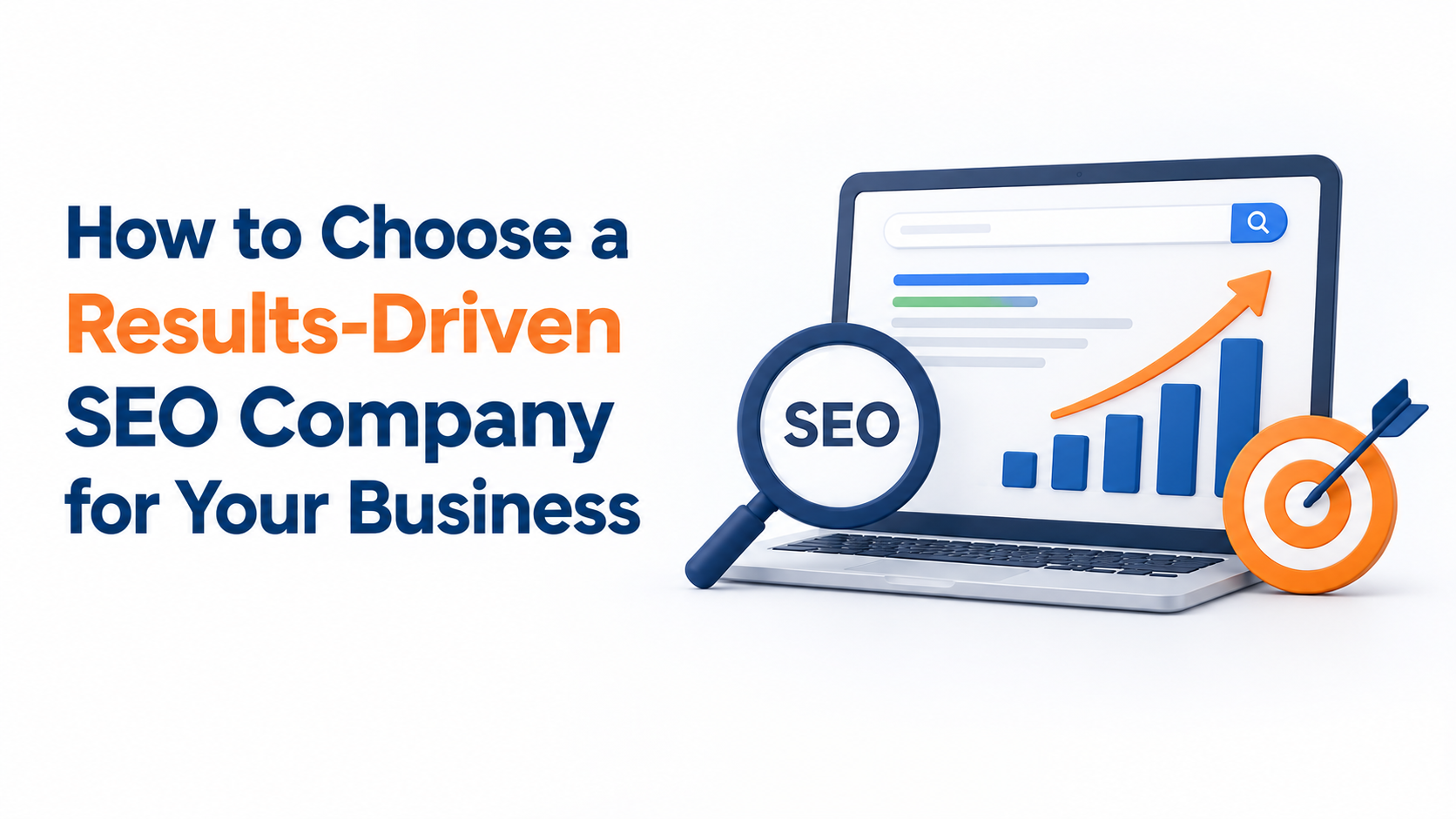
This is where a results-driven SEO company makes a difference.
Instead of treating rankings as the final destination, a results-focused SEO partner connects search visibility with meaningful business objectives. The strategy considers your industry, competition, target audience, website, locations, services, and conversion opportunities.
But with hundreds of SEO agencies offering seemingly similar services, how do you know which one is right for your business?
Here are the key factors to evaluate before making your decision.
1. Start With Your Business Goals
Before comparing SEO companies, define what you actually want SEO to achieve.
Your goal might be:
- More qualified website traffic
- More enquiries and leads
- Better local visibility
- Higher ecommerce sales
- Improved rankings for commercial keywords
- Expansion into new cities
- National or international visibility
- Better organic conversion rates
For example, a manufacturing company may want enquiries from B2B buyers, while a local coaching institute may primarily want calls and admission enquiries.
Both need SEO, but their strategies should not be identical.
A professional SEO company should first understand your business goals rather than immediately presenting a standard package.
2. Look for Strategy, Not Just SEO Tasks
SEO involves hundreds of individual activities, but completing tasks does not automatically create results.
An agency may promise:
- Keyword research
- Blog writing
- Link building
- Technical audits
- On-page optimisation
- Monthly reporting
These are activities. The important question is how those activities work together.
A strong SEO strategy should answer:
Who are we targeting?
What are they searching for?
Which pages should rank?
What competitors are already capturing the demand?
What needs to change on the website?
How will organic visitors become leads or customers?
This strategic layer separates routine SEO execution from business-focused SEO.
3. Examine Their Approach to Keyword Research
Keyword research should go beyond finding keywords with high search volume.
A useful SEO strategy considers search intent.
For example:
“What is cloud hosting?”
This is primarily informational.
“Cloud hosting provider India”
This has stronger commercial intent.
“Buy cloud hosting”
This indicates transactional intent.
If an SEO agency targets only high-volume informational keywords, your traffic may increase without producing enough business enquiries.
Ask the agency how it categorises keywords by intent and how those keywords are mapped to specific website pages.
4. Evaluate Their Technical SEO Knowledge
Content cannot compensate for every technical problem.
Your SEO partner should understand important technical factors such as:
- Website crawlability
- Indexation
- XML sitemaps
- Robots.txt
- Canonical URLs
- Redirects
- Broken links
- Page speed
- Mobile usability
- Core Web Vitals
- Duplicate content
- URL structure
- Internal linking
- Structured data
For example, if important service pages are accidentally blocked from search-engine crawling, publishing more blogs will not solve the underlying problem.
A results-driven SEO company should identify these issues and prioritise them according to their potential business impact.
5. Ask How They Measure Results
This is one of the most important questions to ask an SEO agency.
If the only metric they discuss is keyword ranking, ask for more context.
A useful SEO measurement framework can include:
Visibility → Organic Traffic → Engagement → Leads → Conversions
Depending on your business, you may also track:
- Organic enquiries
- Phone calls
- Form submissions
- Ecommerce transactions
- Revenue from organic search
- Important landing-page performance
- Local actions such as calls and direction requests
Rankings remain useful because they show search visibility, but they should be considered alongside business metrics.
6. Look at Their Reporting Process
A monthly SEO report should help you understand what happened and what comes next.
Avoid reports that simply contain pages of numbers without explanation.
A useful report should clearly communicate:
What was done?
For example, technical fixes, content optimisation, internal linking, local SEO, or authority-building activities.
What changed?
Show relevant movement in visibility, traffic, rankings, leads, or other agreed KPIs.
What was learned?
Explain which pages, keywords, or strategies are producing opportunities.
What happens next?
Provide clear priorities for the upcoming period.
Good reporting turns SEO from an invisible activity into a measurable business process.
7. Check Their Industry and Business Experience
SEO strategies can vary considerably between industries.
A local service business may need location-focused pages and Google Business Profile optimisation.
An ecommerce website may require category optimisation, product-page strategy, technical SEO, and scalable content.
A B2B company may need detailed service pages, industry-specific content, and lead-focused keyword targeting.
An international business may require country-specific landing pages and international SEO considerations.
Ask whether the SEO company has experience working with websites similar to yours.
8. Be Careful With Unrealistic Promises
SEO takes time, especially in competitive markets.
Be cautious when an agency guarantees:
- #1 rankings for specific competitive keywords
- Immediate results
- Thousands of backlinks every month
- Huge traffic increases without understanding your website
- Guaranteed leads regardless of industry or market
- Instant recovery from every Google update
A credible SEO company should discuss your current website condition, competition, industry, resources, search demand, and realistic growth opportunities.
Good SEO is based on continuous improvement, not shortcuts.
9. Ask How They Approach Content
Content should have a purpose.
Publishing ten generic blogs every month does not necessarily create SEO growth.
A better approach connects content with the customer journey.
Awareness
Answer questions potential customers are researching.
Consideration
Help users compare solutions and understand your services.
Decision
Create detailed service, product, location, and commercial pages that address buying intent.
For example, instead of publishing random articles about digital marketing, an agency could create content around specific problems, services, industries, and customer questions that support its commercial pages.
The goal is not simply to publish more content. It is to build useful search visibility that supports the business.
10. Understand Their Link-Building Strategy
Backlinks can contribute to SEO, but quality matters.
Ask an agency:
- Where do backlinks come from?
- How are websites evaluated?
- Is relevance considered?
- Is the content useful?
- How are risky links handled?
- How does link building fit into the overall SEO strategy?
Avoid choosing a provider simply because it promises a large number of links.
A smaller number of relevant, quality-focused activities can be more meaningful than large quantities of low-value links.
11. Evaluate Communication and Transparency
SEO is a long-term partnership.
You should be able to ask questions and receive understandable answers.
Before hiring an agency, find out:
- Who will manage your account?
- How frequently will you receive updates?
- Can you speak with the SEO team?
- How are strategy changes communicated?
- How quickly are technical problems addressed?
- What happens if performance changes unexpectedly?
Transparency matters because SEO decisions can affect your website, content, reputation, and long-term organic visibility.
12. Compare Agencies on Value, Not Just Pricing
The cheapest SEO package is not necessarily the most cost-effective.
Suppose one agency charges less but provides generic content, limited analysis, and basic reporting.
Another agency charges more but provides technical SEO, strategic keyword mapping, content optimisation, competitor research, reporting, and ongoing optimisation.
The correct comparison is not simply:
Agency A = ₹X
Agency B = ₹Y
Instead, ask:
What business value and level of expertise am I receiving for that investment?
Your SEO partner should be capable of explaining what the investment is intended to achieve and how progress will be measured.
A Practical SEO Company Evaluation Checklist
Before signing a contract, ask these questions:
| Question | What You Should Look For |
|---|---|
| Do they understand my business? | Industry and customer-specific strategy |
| Do they analyse competitors? | Competitive search insights |
| Do they perform technical SEO? | Regular technical audits and fixes |
| How do they select keywords? | Search intent and commercial relevance |
| How is content planned? | Content linked to customer needs |
| How are links acquired? | Quality and relevance |
| How are results measured? | Rankings plus traffic and conversions |
| How are reports presented? | Clear, actionable reporting |
| How do they communicate? | Reliable and transparent communication |
| Do they make guarantees? | Realistic expectations rather than unrealistic promises |
Why a Results-Driven SEO Approach Matters
The purpose of SEO is not simply to make a website look successful in a ranking report.
The bigger objective is to build a sustainable organic acquisition channel.
That means attracting the right audience, improving relevant search visibility, creating useful landing pages, strengthening website authority, and continuously improving the path from search to conversion.
This requires SEO to work alongside your wider business strategy.
Ready to Turn Search Visibility Into Business Growth?
Choosing the right results-driven SEO company can have a significant impact on how effectively your business attracts customers through organic search.
The right partner should combine technical expertise, strategic thinking, useful content, competitive research, transparent reporting, and continuous optimisation. Most importantly, the work should remain connected to your actual business objectives.
At UpRankSEO, SEO is approached as a business-growth strategy rather than a checklist of disconnected tasks. Our services cover technical SEO, local SEO, multi-city SEO, national SEO, international SEO, ecommerce SEO, content optimisation, and white-label SEO, allowing strategies to be adapted to different business models and markets.
If you want an SEO partner that focuses on strategy, measurable progress, transparent communication, and long-term organic growth, UpRankSEO can help you build a search strategy around your actual business goals.
Ready to improve your organic growth? Get in touch with UpRankSEO and discuss an SEO strategy built around your business, audience, competition, and growth objectives.