AI tools recommend coaching classes they can find, check and describe clearly. For an institute, that means a page for each course with named faculty, a clear fee and batch structure, listings that agree with each other, and claims the advertising rules allow. The Central Consumer Protection Authority’s coaching guidelines of 13 November 2024 rule out several common claims, so the same clarity also keeps you compliant.
This guide covers why students ask AI first, what the tools read, which claims to drop from your advertising, how to match your listings, how to write course pages and how to test your visibility every month.
Why do students and parents ask AI about coaching classes first?
A Class 11 student who is stuck on calculus rarely starts by browsing a list of institutes. They ask a question: “Which coaching class near Thane station is good for JEE maths?” A parent asks something similar about board preparation for Class 10. The AI answers from whatever it can find about institutes in that area, and it names the ones whose details are easiest to read.

Enrolment is a bigger decision than most purchases. Fees run for a full year, and parents want to know who teaches, how many students sit in a batch and what happens when a child falls behind. A parent who finds the answer on your course page is more likely to call you than one who has to ask. A course page that answers those questions also gives an AI tool something specific to repeat back.
Parents often ask a second question after the first: is it worth the fee? An AI tool cannot judge that for them. It can, however, repeat the facts you publish about the fee, the batch size and the test schedule, and those facts are what let a parent compare you with the institute down the road.
Trust matters too. Parents look for evidence, and some kinds of evidence cannot be invented. The guidelines on coaching advertising are clear about that, as the next sections show.
What do AI tools read when they pick a coaching institute?
BrightLocal recorded the first ten sources that ChatGPT returned for 800 local business searches in November 2024, then sorted them into groups. Business websites made up 58% of the sources, mentions on other sites 27% and directories 15%. The study covered 20 US cities, so treat the split as a guide to priorities, not a forecast for your city. Our AI discovery guide explains how these sources fit together.
BrightLocal also found that ChatGPT draws on review information from Google and Google Maps. The study did not measure how much, so treat reviews as one signal among several.
| What the AI checks | What your institute should show | Why it counts |
|---|---|---|
| Do you teach the course? | One page per course with syllabus, duration and batch size | Business websites were the largest source group in the study |
| Who teaches the student? | Faculty names, qualifications and years of teaching | A named teacher is easier to check than an institute name alone |
| Where are you, and when? | The same address, phone and timings on every listing | Google says complete and accurate information helps local search |
| What do parents say? | Recent reviews that you reply to | Google says positive reviews and helpful replies can help a business stand out |
| Who else mentions you? | News, school tie-ups, association pages and directory listings | Mentions on other sites made up 27% of the sources |
Which advertising claims does the guideline rule out?
The Central Consumer Protection Authority (CCPA) released guidelines on coaching advertising on 13 November 2024, titled Prevention of Misleading Advertisement in Coaching Sector. Business Standard’s report on the guidelines lists the claims they treat as false. These include claims of 100% selection or 100% job security, false claims about courses, faculty credentials, fee structure, refund policies, selection rates and exam rankings, and guarantees of job security or salary increases.
Two more points matter for your website. The guidelines require written consent before a coaching centre uses a successful candidate’s name, photograph or testimonial, and that consent has to be obtained after selection. The guidelines also say disclaimers must be displayed prominently. The report paraphrases the guidelines rather than quoting them, so read the official text before you finalise your copy, and ask your legal adviser to check any claim you are unsure about.
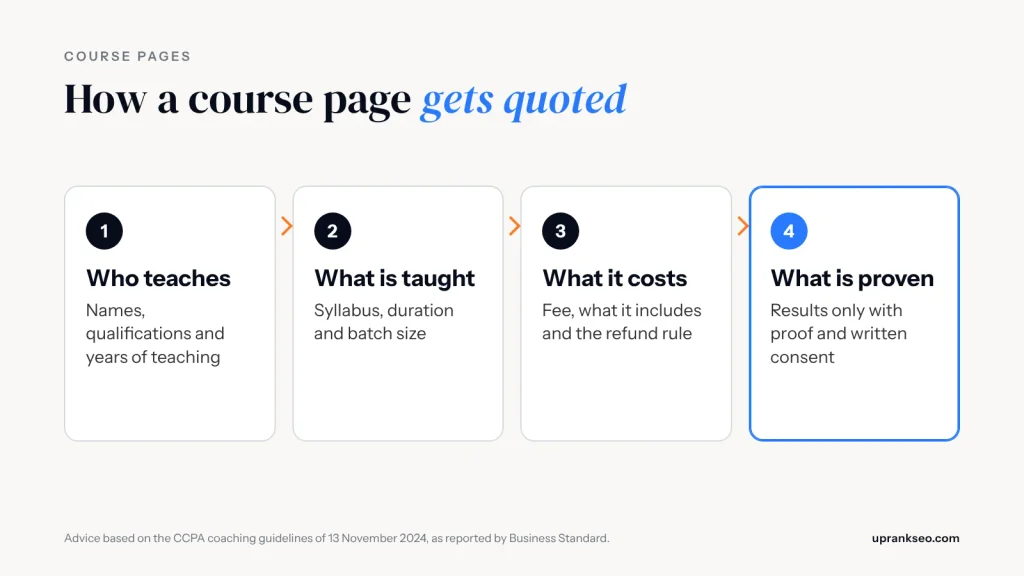
This matters for AI visibility as well. An AI tool can repeat a clear fee table and a named faculty list. It has nothing solid to quote from a page that leans on promises the guidelines forbid.
Which listings should match first?
Start with your Google Business Profile. Google says businesses with complete and accurate information are more likely to show up in local search results, and that inaccurate information can keep a profile from appearing for nearby searches. Choose a category that describes what you teach, keep your hours current and add special hours for exam weeks. Google also says there is no way to request or pay for a better local ranking, so accurate details and genuine reviews are the route that works.
Then check the directories students use in your city, such as Justdial. BrightLocal’s sources were American, so don’t assume its directory picture applies to India. Your job is the same everywhere: one name, one address, one phone number and the same timings on every listing. Keep a single master sheet with the institute’s name, address, phone, timings and faculty details, copy it onto every listing, and check it again whenever a teacher joins or leaves. A faculty member who has left but still appears on a directory is exactly the kind of mismatch that confuses an AI tool. For the listings side of the work, our local SEO service handles the checks.
How do you write course pages that AI can quote?
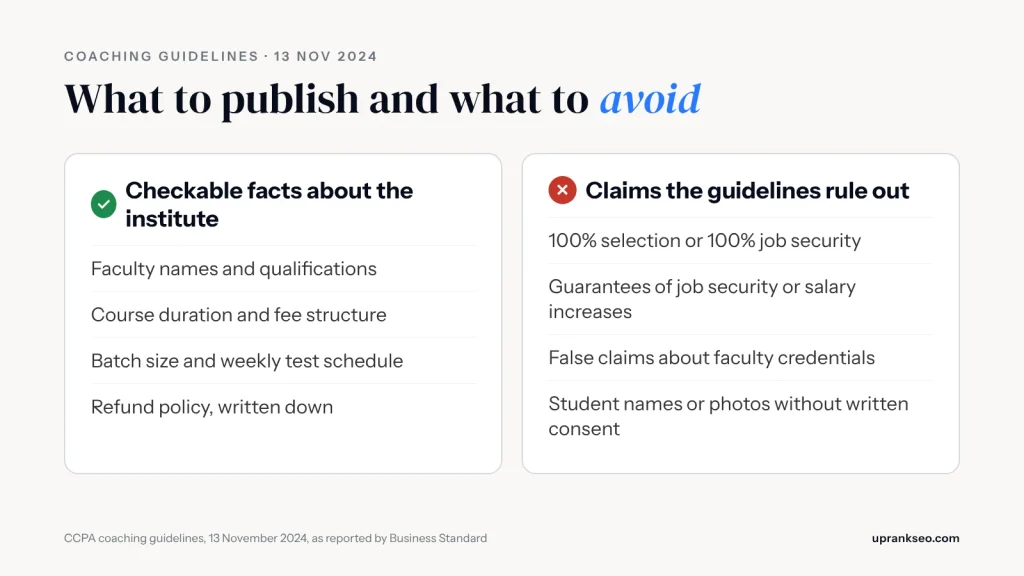
A course page gets quoted when it answers the parent’s question in plain words. Open with two lines on who the course is for and what it covers. Then give the syllabus and duration in order, with the batch size and the weekly test schedule. Name the faculty who teach it, with their qualifications and years of teaching. State the fee, what it includes and your refund rule in writing. Then date the page and review it when the syllabus or the fees change.
Results need extra care. Show a result only when you hold the proof and the student has given written consent to use their name or photograph. If you cannot prove a claim, leave it out. Describe what happens in class and let the detail do the persuading. If you want an outside review of your course pages, our AI SEO service covers that work.
How do you check whether AI recommends your coaching classes?
Run these four questions in fresh chats on ChatGPT, Gemini, Claude and Grok:
- “Which coaching class near Thane station is good for JEE maths?”
- “Which classes in Kalyan teach Class 10 CBSE maths with weekly tests?”
- “Is there a NEET biology coaching in Navi Mumbai with small batches?”
- “Which spoken English class for school students in Thane explains its fees clearly?”
Write down which institutes are named and which pages each tool cites. The cited pages show you where to improve and where to get listed next. Repeat the test every month with the same four questions, and keep a short log with the date, the tool, the question and the institutes named. One check tells you little. A monthly log shows whether your changes are moving the answers. Our case studies show how this kind of project runs.
Frequently asked questions
Can a coaching class claim a 100% selection rate? No. The CCPA guidelines of 13 November 2024 list claims of 100% selection and 100% job security among the false claims. Publish only results you can prove, with the source and the year stated.
Can we show student results on our website? Only with the student’s written consent, obtained after selection, and only for figures you can verify. The guidelines require that consent for names, photographs and testimonials. Ask your legal adviser to confirm the wording before you publish.
Does AI read Google reviews? BrightLocal found that ChatGPT draws on review information from Google and Google Maps. The study did not measure how much, so treat reviews as one signal among several.
Does schema markup help? Google says its AI features need no additional markup. Structured data still helps when it matches the visible text on the page, so add it only where the details are accurate and current.
How long before AI tools notice our changes? OpenAI says a robots.txt change can take about 24 hours to apply for ChatGPT search. Answers change when the tool reads your updated pages, so keep your listings consistent while you wait.
Where should the fee and refund terms appear? The guidelines say disclaimers must be displayed prominently and that course information must be disclosed accurately. Our advice is to put the fee, duration and refund terms where a parent reads them, close to the course description, not buried in a footer.
Find out what AI says about your institute
We’ll ask ChatGPT, Gemini, Claude and Grok the questions your students ask, show you which institutes get named and list the details that don’t match. It’s free. Request your AI visibility check.