If you want AI tools like ChatGPT, Gemini, Claude and Grok to recommend your eye hospital, make the facts about your hospital easy for them to find and check. That means a clear page for every procedure and every doctor, Google, Bing and Practo listings that match each other, genuine reviews, and mentions on other trusted sites. It also means staying inside the NMC’s new advertising rules, which came into force on 6 October 2026.
This guide walks through each of those, in the order we’d tackle them for a hospital in Thane, Kalyan or anywhere else.
Why patients now ask AI before they call
Choosing where to have cataract surgery isn’t a quick decision. Patients want to understand lens options, recovery time and cost before they book a consultation. A young professional thinking about LASIK wants to know if they’re even suitable. Increasingly, they ask an AI assistant first.
The numbers back this up. A January 2026 report from OpenAI, covered by Business Today, said around 40 million people use ChatGPT for health questions, and 44% of those surveyed had used it to look into treatment options. Closer to home, a Digit reader poll of about 5,000 people found a quarter turn to an AI chatbot first when they feel unwell. It’s a self-selected poll, so read it as a direction rather than a census.
Once a patient understands the treatment, the next question is “where should I get this done?”. That’s the moment your hospital needs to be in the answer.
What do AI tools look for in an eye hospital?
There’s no approved list. When a patient asks, the AI searches the web, reads a handful of pages and names the hospitals those pages describe clearly. Our guide on how AI tools decide which business to recommend goes into the mechanics.
For an eye hospital, these are the things that count.
| What the AI checks | What you should publish |
|---|---|
| Do you offer the treatment the patient asked about? | A separate page for cataract, LASIK, glaucoma, retina, cornea and paediatric care |
| Who treats patients, and are they qualified? | A doctor directory with qualifications, registration numbers and specialities |
| Are you near the patient? | The same name, address and phone on your site, Google, Bing and directories |
| What do other people say? | Genuine reviews, news coverage, association and insurance network listings |
| Can the details be checked? | Charges, timings, facilities and accreditations written out in plain text |
Slogans don’t appear anywhere in that table. “Advanced care with a human touch” gives an AI nothing to repeat. “Phaco cataract surgery with monofocal and multifocal lens options, Monday to Saturday, Thane West” does.
Step 1: Give every procedure its own page
This makes the biggest difference, and most hospital websites skip it. They have one Services page with a list of treatments, which tells an AI almost nothing.
A good procedure page opens with two or three plain sentences that answer the obvious question. After that it covers what patients actually want to know:
- What the procedure is, and who it’s for
- How you decide whether a patient is suitable
- What happens on the day, and how long recovery takes
- The risks, stated honestly
- The cost. The NMC allows hospitals to publish charges and packages as long as they’re factual and not misleading, so a range with what’s included works well.
- Which of your doctors perform it
Keep the language simple and add a short FAQ at the bottom. We’ll cover cataract and LASIK cost pages in detail in a separate guide.
Step 2: Publish a proper doctor directory
Patients ask about doctors by name and by speciality. “Who’s a good retina specialist in Thane?” is a very common question.
Under the new guidelines, a hospital’s list of doctors counts as patient information rather than advertising, so you can use it fully. For each doctor, include their full name, qualifications, medical council registration number, specialities, the procedures they perform, consultation days and the languages they speak.
Keep the tone factual. Words like “renowned” or “top” are best left out, because the guidelines only allow superiority claims you can objectively prove.
Step 3: Get your listings complete and consistent
AI tools trust details that agree with each other. Go through every place your hospital appears.
Your Google Business Profile comes first. Pick accurate categories such as “Eye care center”, add each service, and fill in hours and photos. Google itself says “businesses with complete and accurate info are more likely to show up in local search results”.
Then Bing Places, which almost everyone forgets. Independent tests show ChatGPT’s search draws mostly on Bing, so an empty Bing listing costs you there.
After that, Practo, Justdial and other health directories, which patients use and AI tools read. And if you’re on any insurance or TPA cashless network lists, check those entries too. They’re strong, verifiable mentions.
The name, address, phone number and timings should be identical everywhere. One old number on Justdial is enough to create doubt.
Step 4: Earn reviews the right way
Reviews still matter. Google says “more reviews and positive ratings can help your business’s local ranking”, and good reviews tend to get repeated on the pages AI tools read.
The rules have tightened, though. The NMC’s ethical advertising guidelines of 6 October 2026 prohibit buying or manipulating reviews and ratings, and they bar patient testimonials in promotion. In practice:
- Don’t buy, script or reward reviews. No discounts or gifts in return.
- Don’t post patient stories or testimonials on your website or social media to promote the hospital.
- Reply to reviews politely, and never confirm or discuss a patient’s treatment in a reply.
- If you’re unsure whether something is allowed, check with your legal adviser first.
When the patient experience is good and leaving a review is easy, genuine reviews come in steadily on their own. That steady flow is what search engines and AI tools pick up.
Step 5: Get mentioned on other trusted sites
What others say about you carries more weight than what you say about yourself. In BrightLocal’s study of ChatGPT searches, mentions on other websites made up 27% of the sources it cited.
For an eye hospital, these mentions come quite naturally: local news coverage of a free eye camp or school screening drive, talks at medical conferences and CME programmes listed on the organiser’s site, membership listings with ophthalmology societies, NABH accreditation listings, and insurance network or corporate tie-up pages. Each one is a page you don’t control that confirms who you are and what you do.
Step 6: Make sure AI tools can read your site
None of the above helps if AI tools can’t get to your pages. Check that your robots.txt doesn’t block search crawlers. OpenAI says sites that block its OAI-SearchBot “will not be shown in ChatGPT search answers”. Add your site to both Google Search Console and Bing Webmaster Tools. Keep key facts as text rather than inside images or PDFs, add MedicalClinic and Physician schema that matches what’s on the page, and make sure pages load quickly on a phone, since that’s where most patients search.
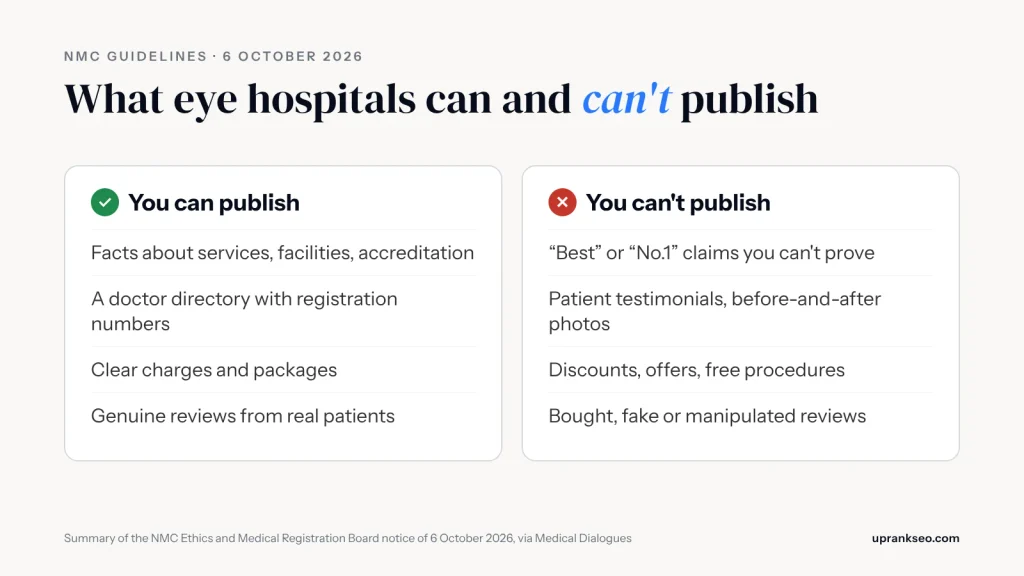
What can’t an eye hospital publish any more?
The October 2026 guidelines cover doctors, hospitals, and the agencies and platforms working for them. Handing a task to an agency doesn’t move the responsibility. Penalties for doctors range from a warning to suspension of registration.
| You can publish | You can’t publish |
|---|---|
| Factual details of services, facilities and accreditation | “Best eye hospital”, “No.1 LASIK surgeon” or “100% success” without verifiable proof |
| A doctor directory with qualifications and registration numbers | Patient testimonials or celebrity endorsements |
| Clear, factual charges and packages | Discounts, limited-time offers, free procedures or referral benefits |
| Anonymised cases for education, with consent | Before-and-after photos or promotion of surgical results |
| Genuine reviews from real patients | Bought, fake or manipulated reviews, ratings or followers |
| AI-assisted content that’s clearly marked as AI-generated | AI-generated promotional campaigns, or AI-made patient images or testimonials |
You can read the full summary on Medical Dialogues, and it’s worth running your plans past your legal adviser.
Everything in this guide sits in the left-hand column. You’re not gaming anything. You’re making true information easy to find.
What kind of results are realistic?
That depends on your city, your competition and where you’re starting from. Here’s one example from our own work.
One of our clients is an eye-care centre in Bhiwandi with more than 25 years of practice. After a focused local visibility campaign, its Google Search numbers moved like this: organic clicks went from 1.99K to 3.47K, impressions from 370K to 914K, and its average keyword position from 11.3 to 5.3.
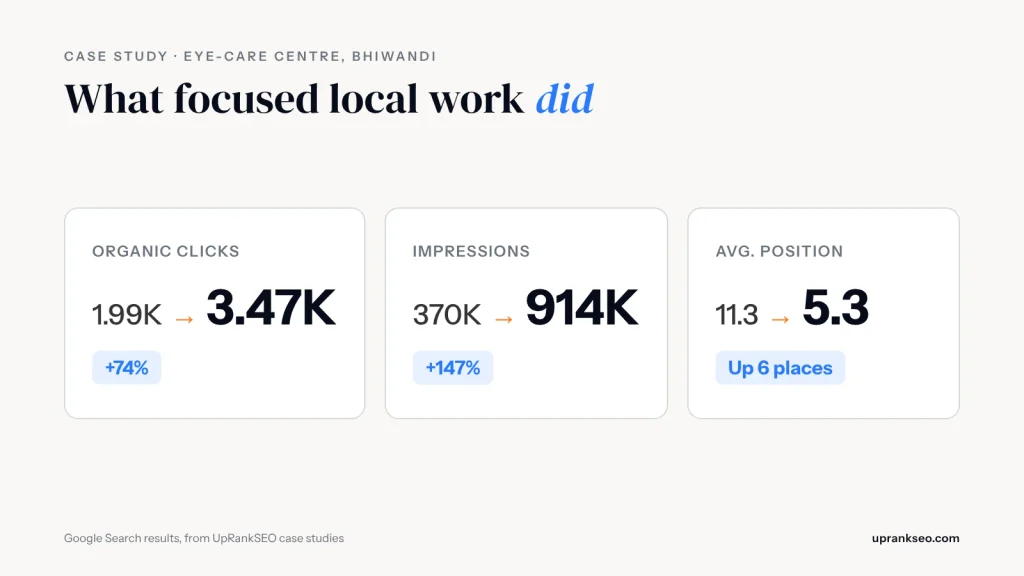
To be clear, those are Google results, not AI results. They matter here because AI tools read the pages that rank well. Moving from page two to the top half of page one puts a hospital in front of far more of the sources AI tools draw from.
How do you check whether AI recommends your hospital?
Test it once a month. Open ChatGPT, Gemini, Claude and Grok in fresh chats and ask what your patients ask:
- “Which hospital in Thane is good for cataract surgery?”
- “Where can I get LASIK done in Navi Mumbai, and what does it cost?”
- “Who is a good retina specialist near Kalyan?”
- “Which eye hospitals near me accept cashless insurance?”
Write down whether your hospital is named, where it appears and which pages each tool cites. Those cited pages tell you where to get listed next.
Frequently asked questions
Can an eye hospital pay to be recommended by ChatGPT or Gemini? No. These tools name hospitals based on the pages they read. The NMC guidelines also prohibit manipulating search rankings to create a misleading impression, so build visibility on accurate, checkable information.
Are we allowed to publish surgery prices on our website? Yes, if they’re factual and transparent. The guidelines allow lawful disclosure of charges and packages. What they prohibit is discounts, limited-time offers and free procedures that push patients towards treatment.
Can we still ask patients for Google reviews? Genuine reviews are fine. Buying, scripting, faking or rewarding reviews isn’t, and testimonials can’t be used in promotion. Check your process with your legal adviser.
Do ChatGPT, Gemini and Claude need different strategies? Mostly the same work serves all of them. Google says its AI features need no special optimisation. For ChatGPT, also make sure Bing has indexed your site and your hospital appears on trusted third-party pages.
Can we use AI to write content for our hospital? AI can help with drafts, but the NMC prohibits AI-generated promotional campaigns and requires AI-generated content to be marked. A doctor should check every medical fact before it goes live.
How long does it take to see results? Google rankings usually take three to six months to improve meaningfully. AI answers that rely on live search can change within weeks once your pages rank. What AI models know from training changes more slowly.
Does a hospital with several branches need separate pages? Yes. Each branch needs its own page and its own Google Business Profile, with its own doctors, timings and services. Our Multi-City SEO service covers this.
Find out what AI tells your patients
We’ll ask ChatGPT, Gemini, Claude and Grok the questions your patients ask, show you which hospitals get named, and give you a list of fixes that stay within the NMC guidelines. It’s free. Request your AI visibility check.