If you want ChatGPT, Gemini, Claude and Grok to recommend your salon or beauty parlour, make the facts about it easy to find and check. That means one clear page for each main treatment, a Google Business Profile and directory listings that match each other, genuine reviews, and mentions on sites you don’t control. Every claim you make should also be one you can prove.
This guide walks through those steps for a salon in Thane, Mumbai, Navi Mumbai or Kalyan. It also covers what to leave out of your own ads, because a claim you can’t back up is a problem even when it helps you rank.
Why are customers asking AI before they book a salon?
Picture a bride in Navi Mumbai with six weeks to go. She wants a makeup artist who offers a trial session, suits her skin tone and comes to the house on the day. Instead of scrolling through pages of photos, she types the whole question into an AI tool. The answer names two or three businesses, and yours is either one of them or it isn’t.
Plenty of customers still walk in off the street, and word of mouth still matters. But the question someone types into an AI tool is a moment you can prepare for, so it’s worth knowing what the tool will find.

There’s no approved list of salons that these tools check against. When someone asks, the tool searches the web, reads a handful of pages and names the businesses those pages describe clearly. Our guide on how AI tools decide which business to recommend covers the mechanics, so this article focuses on the parts that matter for a salon.
What do AI tools look for in a salon?
Think of it as a checklist the tool is working through, even though it never writes one down.
| What the AI checks | What to put in front of it |
|---|---|
| Which treatments you offer | A page for each main service, such as keratin, hair spa, bridal makeup or waxing |
| Where you are | Your area and nearby landmarks in plain text, such as Thane West or Naupada |
| Who does the work | Named stylists or artists, and what each one specialises in |
| What it costs | A price list or “starts at” prices, with what each price includes |
| What clients say | Genuine Google reviews, your replies to them, and mentions on other sites |
| Whether the details agree | The same name, address, phone and timings everywhere |
Vague marketing gives the tool nothing to repeat. “A luxury beauty experience” could be any salon in India. “Keratin smoothing for frizzy hair, with a cut and blow-dry included, Thane West” tells the tool exactly what you do and where.
Does your Google Business Profile still matter for AI answers?
Yes, and for Google’s own AI features it matters a lot. Google says AI is “built into Search and integral to how Search functions”, so your Business Profile counts in those answers too.
Google’s help page says that “businesses with complete and accurate info are more likely to show up in local search results”. Choose the category that describes what you do, keep your hours right and add photos of your work, since Google says photos help you show customers what you offer. If the details are wrong, Google warns that your profile might not show up for relevant searches in your area.
ChatGPT’s route is less direct. OpenAI says its crawler, OAI-SearchBot, “is used to surface websites in search results in ChatGPT’s search features”. Check that your robots.txt isn’t blocking it, because OpenAI also says sites that opt out “will not be shown in ChatGPT search answers”. OpenAI says a robots.txt change can take about 24 hours to apply, so this is one of the quickest fixes on the list.
Gemini, Claude and Grok each work differently under the hood. The same basics serve all of them: a page that says what you do, listings that agree and reviews people can read. If you’d rather have someone handle the listings, our local SEO and AI SEO services cover that work.
Should every treatment have its own page?
For your main treatments, yes. A single “Services” page with twenty treatments in a grid tells an AI almost nothing about any one of them. A separate page for keratin, another for bridal makeup and another for hair spa each gives it something specific to quote.
Open each page with two plain sentences: what the treatment is and who it suits. After that, cover:
- How long it takes, and how often clients need it
- What’s included, such as products, a consultation or aftercare
- Who performs it, by name
- What it costs, or a “starts at” price and what changes it
- Whether it happens in the salon, at home or on event days
Don’t pad the page with details you can’t back up. A line such as “dermatologist approved products” needs proof you can show, and the next sections explain why.
Google’s guidance on local business markup helps here too. It asks sites to “use the most specific LocalBusiness sub-type possible”, and its general rules say that your structured data must be “a true representation of the page content”. If your markup describes a spa, your page should describe one as well.
Do reviews and mentions on other sites count?
Reviews still matter. Google says that “more reviews and positive ratings can help your business’s local ranking”. Ask every happy client for a genuine review, reply to each one, and never buy them. Reviews that name the treatment and the area help both a reader and an AI tool match a review to the question being asked.
Mentions matter too. A local news piece about a free skin camp you hosted, a bridal fair listing, a wedding vendor directory, a Justdial or Sulekha profile with the same details as your website, and a photographer or boutique that links back to you are all pages you don’t control that confirm who you are. Instagram helps people find you, but the answers AI tools give usually draw on web pages and listings, so keep your key facts there as well.
For a sense of what local listing work can do, a web agency in Wagle Estate, Thane reached first place on Google Maps for four straight months. That agency isn’t a salon, so treat it as proof of the method rather than a salon result. These are Google Maps results, not AI results.
What can a salon say in its own marketing?
The rules in this section are guidance for your own ads and posts. They aren’t a compliance checklist, so check anything important with a legal adviser.
The Central Consumer Protection Authority has issued guidelines on misleading advertisements and endorsements. They aim to stop unsubstantiated claims, exaggerated promises and false claims. The official release says the authority can impose penalties of up to ₹10 lakh for a misleading advertisement, rising to ₹50 lakh for repeat cases, and can stop an endorser from endorsing for a period. The guidelines also set out rules for bait advertising and “free” claims, so a free trial needs clear terms.
The advertising industry’s self-regulatory ASCI Code says that descriptions and claims of objectively ascertainable fact must be substantiated, and that ads must not mislead through implication or omission.
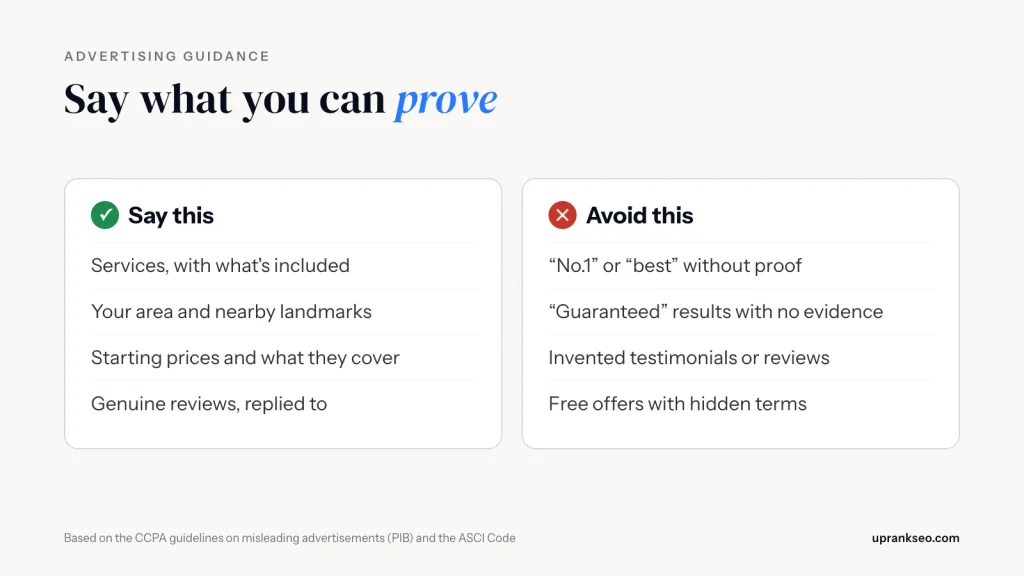
In practice, “India’s No.1 salon” needs a ranking you can show. “Guaranteed results” needs evidence. A discount that ends on a set date should say so clearly. Describe what you actually do instead: years of practice, qualifications you can verify and the products you use, named on the page.
How do you check whether AI recommends your salon?
Test it once a month. Open ChatGPT, Gemini, Claude and Grok in fresh chats and ask what your customers ask:
- “Which salon in Thane does a good keratin treatment for frizzy hair?”
- “Who does bridal makeup with a trial session in Navi Mumbai?”
- “Where can I get a hair spa in Kalyan on a Sunday?”
- “Which unisex salon near Mumbai Central takes walk-ins for beard grooming?”
Answers change from one chat to the next, so one test proves little. Write down whether your salon is named, where it appears in the answer and which pages each tool cites. Those cited pages show you where your next listing or mention should go.
Frequently asked questions
Can a salon pay ChatGPT or Gemini to recommend it? The tools name businesses from the pages they read, so the work is to make those pages clear and earn mentions on other sites.
Does a salon need a separate AI SEO strategy? Mostly not. Google says its AI features are part of Search and have no additional technical requirements, so good local SEO covers Gemini and AI Overviews. For ChatGPT, make sure OAI-SearchBot isn’t blocked and that your listings agree with your website.
Do I need to be on Instagram to appear in AI answers? No, although Instagram helps people find you. AI answers usually draw on web pages and listings, so the details that matter most need to be there, written in plain text.
Do reviews affect what AI tools recommend? Google says reviews and positive ratings can help a business’s local ranking, and its AI features sit on top of Search. Reviews also get repeated on directories and blogs, which other tools read. Ask for genuine reviews and reply to every one.
Can I say my salon is the best in Thane? Only if you can prove it. The ASCI Code says claims of objectively ascertainable fact must be substantiated, and the CCPA guidelines target exaggerated promises. Describe what you can show instead, such as years of practice, named qualifications and the treatments you’re known for.
How long before my salon shows up in AI answers? Answers built from live search can change quickly once your pages are indexed and ranking, though there’s no fixed timetable. OpenAI says robots.txt changes can take about 24 hours to apply to its search. What a model knows without searching changes much more slowly.
Find out what AI says about your salon
We’ll ask ChatGPT, Gemini, Claude and Grok the questions your customers ask, show you who gets named, and tell you what’s holding you back. It’s free. Request your AI visibility check.