

A price list only helps if AI tools can read it. Put each service on its own line, with a price or clear range, the time it takes and what’s included. Keep it as plain text on a page search engines can crawl, not in a photo of the wall card. Then ChatGPT, Gemini, Claude and Grok have a figure to quote when someone asks how much.
Most salons in Thane, Navi Mumbai and Kalyan already have a price list. The trouble is where it lives: a laminated card at the desk, an Instagram highlight or an old WhatsApp forward. None of those is a page an AI tool can reliably read or cite. This guide covers what to publish, how to show a price range without sounding evasive, and how to check what the AI says back.
What happens when someone asks an AI tool how much a service costs?
Picture a woman in Thane who types, “How much does keratin cost in Thane?” An AI assistant can’t know today’s rates from memory, and salon prices change often, so it searches. It reads a handful of pages, keeps the ones that state a figure clearly, and writes a range from what it found. If your keratin price sits on a page it can read, you’re in that range. If your only figure is in a photo, the answer quotes someone else.
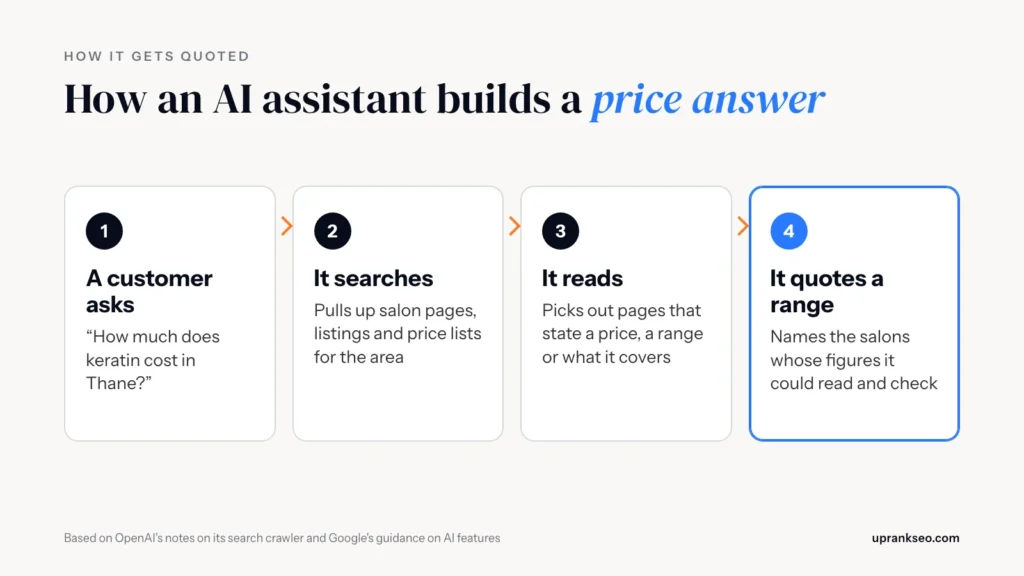
The reading part is more ordinary than it sounds. OpenAI says its search crawler, OAI-SearchBot, “is used to surface websites in search results in ChatGPT’s search features”. A site that opts out “will not be shown in ChatGPT search answers”. Google’s AI Overviews and AI Mode work from normal Search results, and Google says there are “no additional technical requirements”. For a salon, that means the price page has to be indexed like any other page, with the figures written out in the text.
Our guide on how AI tools decide which business to recommend covers the wider picture, and our AI SEO service covers the work behind it.
Should a salon publish its prices at all?
Many owners hold back. Prices move with hair length, thickness, the product used and the stylist’s level, so a single number feels unfair. But a “call for pricing” page gives an AI tool nothing to quote, and the customer who asked the question books the salon that did answer. A range with the reasons behind it is the better middle ground.
Be careful with the wording, though. India’s Central Consumer Protection Authority has guidelines on misleading advertisements. They’re written for advertisers, so read them as guidance for your own marketing rather than legal advice. They describe a bait advertisement as one where a service is “offered for sale at a low price to attract consumers”, and say a disclaimer must not “hide material information” about a claim. In plain terms, a “from” price is fair when the page also shows what makes the bill higher. A headline price for the shortest hair, with no note, reads like bait.
What should each line of a price list say?
Each service needs a few parts. Here is what to put on every line, and why an AI tool needs it.
| Element | Why an AI tool needs it |
|---|---|
| The service, with length or type (“Keratin smoothing, shoulder length”) | It matches the words a customer actually types |
| A price, or a range in ₹ | It’s the figure the question asks for |
| Time taken | Customers want to know how long the chair is theirs |
| What’s included | Stops a low figure being read as the full cost |
| What changes the price | Explains the range instead of hiding it |
| Aftercare or top-ups | Heads off the surprise bill that ends in a bad review |
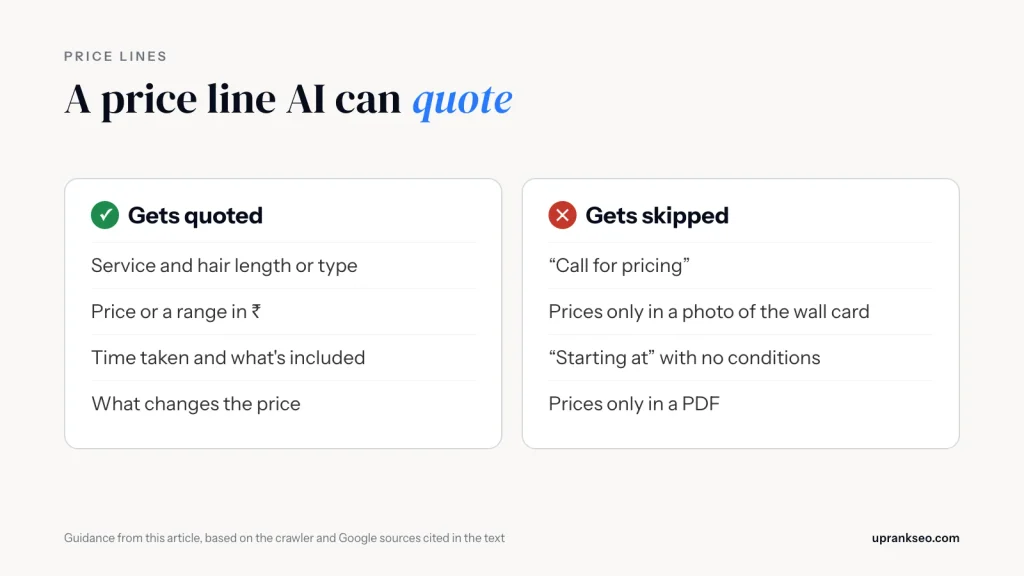
Keep all of it in the page body as text. A customer can read a wall card, but a crawler can’t. Put each service in a heading or a table row, and don’t bury the figures inside an image or a downloadable PDF. Name the service the way a customer would type it. “Keratin” is what people search for, and “smoothing treatment” is often what’s printed on the card. Use both.
How do you show a range without sounding vague?
Take keratin, the question in the title. Its price depends on hair length, how thick the hair is and which product you use. So write out the bands: short, medium and long hair, each with its own price. Add a sentence on how long the treatment takes and a line on what’s covered, such as the wash and the conditioning afterwards.
Then add the sentence that matters most: the final figure is confirmed at the chair after a quick look at the hair. It’s honest, it’s short, and it tells the customer the range is real. Don’t publish a figure you’d have to argue for at the desk.
Use the same labels your stylists use at the chair. If the staff say “medium length” and the card says “M”, the page should say “medium length” too. A customer who types the phrase they heard in the salon then finds the same words on the page, and the AI has an easier job matching your figure to the question.
Can you add prices to your Google Business Profile?
Some businesses can. Google’s help page says that “you can group services into categories and include additional details, like descriptions and prices”, and that the option is open to “Businesses in certain categories, like service businesses”. Keep the price out of the service name, though. Google asks you to avoid “prices, or phone numbers in custom service names”.
The rest of the profile has to agree with your price page. Google says that “businesses with complete and accurate info are more likely to show up in local search results”. Our local SEO service covers listings for salons across Thane and Navi Mumbai.
Check what Google shows, too. In an older report, local SEOs found Google Business Profile displaying service prices the business never set, and in one case a service was labelled “free” that nobody had marked that way. Search Engine Roundtable reported it. Look at your services after every save, and fix any figure that’s wrong.
Does schema markup help a price page?
Not much on its own. Google says there’s “no special schema.org structured data that you need to add” for its AI features. Schema.org does have a type for this, PriceSpecification, which it describes as “a structured value representing a price or price range”. Add it only if your website platform makes it easy, and only with figures that match the visible page. A plain table does more work than markup alone.
How do you check whether AI recommends your salon?
Test your price pages once a month. Open ChatGPT, Gemini, Claude and Grok in fresh chats and ask:
- “How much does keratin cost in Thane?”
- “Which salon in Navi Mumbai lists its gel manicure prices?”
- “What does a hair spa cost in Kalyan, and what’s included?”
- “Is there a salon in Mumbai that shows balayage prices by hair length?”
Note whether your salon is named, whether its figure is right and which page each tool cites. If the figure is wrong or missing, fix the page the AI cites first. Expect different tools to quote different salons, so check more than one.
Frequently asked questions
Can I just write “call for pricing” on my website? You can, but an AI tool has nothing to quote. The customer asking the question will book a salon that answered, so show a range with what changes it. That keeps the price honest and gives the AI a figure to repeat.
Is a “starting at” price allowed? Yes, if it’s a price you’ll honour for that service and the page shows what makes the final bill higher. A low starting figure with no conditions is the kind of offer the CCPA guidance describes as bait, so treat it with care.
Does Google show my prices automatically? Sometimes. Google lets some service businesses add prices to their profile, and it has also displayed prices that owners never entered. Check your services after each change and correct anything wrong.
Do ChatGPT, Gemini and Claude read prices differently? They all read the pages they find, so one clear price page helps every tool. ChatGPT uses its own crawler, OAI-SearchBot, while Google’s AI features run on Google Search, so the same page can be picked up in different ways. That’s why the monthly check matters.
Does a salon chain need a price page for each branch? Yes, if prices differ between branches. Each branch needs its own price list and its own Business Profile with the right figures. Our multi-city SEO service covers that setup.
Find out what AI says about your prices
We’ll ask ChatGPT, Gemini, Claude and Grok the price questions your customers ask, show you which salons get quoted, and check whether your figures are the ones they use. It’s free. Request your free AI visibility check.