
Yes, if your guides answer the questions clients actually type. People ask ChatGPT, Gemini, Claude and Grok things like how to restart a SIP after a missed payment, or how to plan income after retirement. A firm with one clear page per question, all linked to one main guide per topic, gives AI tools specific answers to quote. That linked set is a topic cluster.
This guide covers what a cluster is, which three topics most advisers should start with, how to write pages an AI tool can quote, and what SEBI’s advertising code means for a guide that sits on your website.
What is a topic cluster, and why do AI tools care?
A cluster has three parts. There’s a main guide for each topic, a set of narrower pages that each answer one question, and links between the two. Take SIP investing. The main guide explains what a SIP is, how the monthly debit works and where it fits in a family’s plan. The narrower pages answer questions like “What happens to my SIP if the bank declines the debit?” and “How do I increase my SIP amount?”
AI tools search the web, read a handful of pages and name the sources that answer clearly. One long guide covers a topic in general terms. A cluster answers twenty specific questions, and each answer gives the tool something to link to. If you want the wider mechanics, our guide on how AI tools decide which business to recommend walks through the steps.
Google’s own guidance points the same way. Its page on creating helpful, reliable, people-first content says that people-first content is “created primarily for people, and not to manipulate search engine rankings.” It also says that “SEO can be a helpful activity when it is applied to people-first content.” So you don’t have to choose between writing for clients and writing for search. Write for clients first, then make the pages easy to find.

Which topics should the first cluster cover?
Start with three topics that suit a first cluster: tax, SIP investing and retirement. Each one gets a main guide and a set of questions underneath it.
| Cluster | Main guide covers | Questions clients type |
|---|---|---|
| Tax | How a salaried client or investor plans tax across the year | What paperwork do I need if I sold mutual funds? Which tax-saving options suit a salaried couple in Thane? |
| SIP investing | What a SIP is, how the debit works, how to change or stop one | What if my SIP debit fails? Can I skip a month? |
| Retirement | How savings, investments and insurance fit together after work | How do I plan income once I stop working? Which accounts should I use for retirement savings? |
Tax rules and deadlines change with each Budget and each filing season. Date every tax page and review it at least once a year. A tax guide that still shows last year’s rules does more harm than no guide at all.
How do you write a guide an AI tool can quote?
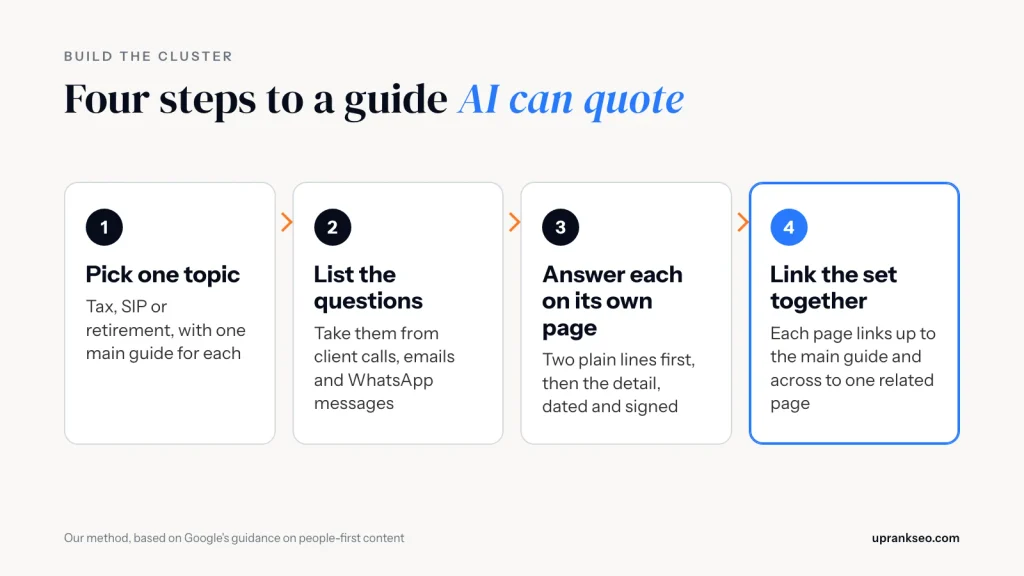
Open each page with two plain lines. Say what the thing is and who it suits. A page on SIPs for a salaried family in Kalyan might start with: “A SIP is a fixed amount you invest in a mutual fund on a set date every month. It suits people who earn a regular salary and want to invest without timing the market.”
After that, cover what the reader actually wants to know: how the debit works, what to do when it fails, how to change the amount, and what a SIP does not do. It doesn’t guarantee a return, and the page should say so in plain words.
Put your name, your SEBI registration number and the date on every page. Google’s guidance says clear authorship and honest disclosure help build trust, and it holds topics that affect money, health or safety to a higher standard. A signed, dated page with a registration number is easier to trust than an anonymous one, for a client and for a tool deciding whom to name.
How do you link the pages and keep the details matching?
Each narrow page should link up to its main guide, and across to one related page. A tax page links to the SIP page where it makes sense. The main guide links down to every question. That’s enough structure for a reader to move around, and enough for a crawler to see how the topics fit.
Local details matter here too. A firm in Thane with a second office in Navi Mumbai needs a separate listing for each office, with the same name, registration number and phone number on every page and profile. Our local SEO service covers the listing side, and our AI SEO service covers the crawler and technical side. If you’re still working out your own site, our guide on getting AI tools to recommend your advisory practice covers the rest.
What does SEBI’s advertising code mean for an educational guide?
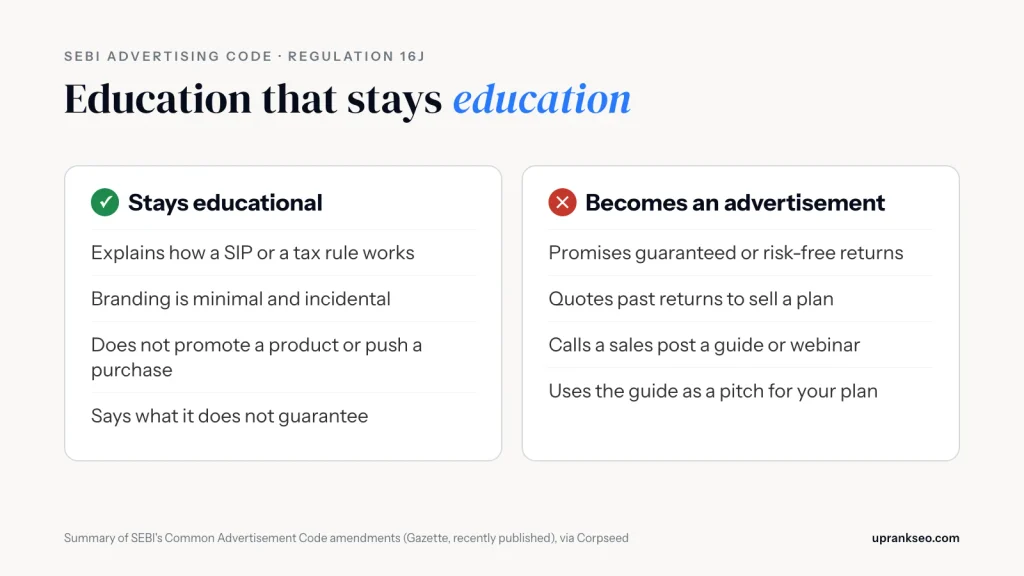
This is the part that changes how you write. Corpseed’s summary of SEBI’s Common Advertisement Code says the amendments were published in the Official Gazette recently. The code leaves out communication that is purely educational or investor-awareness oriented, but only when three conditions hold, under Regulation 16J as the summary describes them. The branding is minimal and incidental. The content doesn’t promote a product or service, or push a purchase decision. And any funds spent on the education are reported to the regulator.
Calling a promotional post a webinar or an educational post doesn’t take it outside the code. The same summary says the code bars promises of guaranteed, risk-free or indicative returns in advertisements generally (Regulation 16O). So a retirement guide can explain how a plan works, but it shouldn’t promise an outcome or quote past returns to sell one.
The start date is less clear. The summary says the amendments come into force on the 180th day after gazette publication, but its page also gives a separate issue date. Check the gazette text with your compliance adviser before you plan around that timing. Whether a contact button at the end of a guide counts as pushing a purchase is also a question for them, and it’s better to ask than to guess.
What kind of results can a firm expect?
Fair question, because we don’t yet have a published case study from a financial adviser. The closest example is a produce exporter in Thane that sells to the USA. Its AI assistant referrals went from 0 to 43 a month. Those referral figures come from AI assistants. Its keyword results, with nine of 14 US keywords in the top 3, are Google Search results, not AI results.
Read that as proof that the work can move both, not as a forecast for your firm. Results depend on your city, your competitors and how much you already publish.
How do you check whether AI recommends your firm?
Test it once a month. Open ChatGPT, Gemini, Claude and Grok in fresh chats and ask what your clients ask:
- “Who is a fee-only financial adviser in Thane who helps with SIP planning?”
- “Which financial advisers in Navi Mumbai explain retirement planning in plain English?”
- “How should a salaried person in Mumbai plan their tax, and which advisers can help?”
- “Which SEBI-registered adviser near Kalyan charges a flat fee for a financial plan?”
Note whether your firm is named, which firms are named instead, and which pages each tool cites. The cited pages show where your cluster has gaps.
Frequently asked questions
Do I need a page for every tax, SIP and retirement question? No. Start with the questions that come up on your client calls and emails, pick the ten that appear most, and write those first. One short page that answers a question well beats a long page that answers ten badly.
Can a disclaimer make an educational guide safe? Not on its own. The Corpseed summary says labelling promotional material as educational doesn’t exempt it, so the content has to pass the test itself: no promotion, no push to buy, and minimal branding.
Does a topic cluster help with Google rankings too? Yes, if the pages are written for people. Google says SEO can be a helpful activity when it is applied to people-first content, so the same pages can serve clients and search.
Can I show a return in a retirement example? Keep examples illustrative and never promise a return. Have your compliance adviser check any figure before it goes on a page.
How often should a guide be updated? Review every tax guide at least once a year, and again whenever the Budget or the filing rules change. Put the date at the top so readers and AI tools can see how current the page is.
Should a guide mention how we charge? Yes, in plain words. Clients and AI tools both look for how a firm is paid. State it as a fact, such as a flat fee or a percentage, and leave out any sales pitch.
Find out what AI says about your firm
We’ll ask ChatGPT, Gemini, Claude and Grok the questions your clients ask, show you which advisers get named, and tell you which guides to write first. It’s free. Request your AI visibility check.