AI assistants recognise an online coach when the facts about that person agree everywhere and are easy to check. ChatGPT, Gemini, Claude and Grok look for a clear name, an About page that says who you are and what you teach, course pages with real details, and a few honest mentions on other sites. A big follower count helps much less than most coaches expect.
Our guide on how AI tools decide which business to recommend covers the mechanics. This one is about you as the business: the pages to fix, the reviews and endorsements to handle with care, and the rules that apply to coaching ads in India.
Why does AI name one online coach and skip another?
A Class 10 maths teacher in Kalyan runs recorded lessons and weekend Zoom batches. A parent in Thane types, “Which online maths tutor for Class 10 CBSE has weekly tests?” The AI searches the web, reads a handful of pages and names the teachers whose pages answer that question in plain words.
The trouble for coaches is that there’s no shopfront. A plumber in Kalyan has a van, a phone number and a listing on the map. An online coach has only the pages and profiles they’ve made, plus whatever other people write about them. So those pages carry all the weight.
Do followers make AI recommend you?
Not on their own. Followers are a number inside an app. Most of what an AI tool quotes comes from pages it can open and read, so a reel with lots of views doesn’t tell the tool what you teach, who it’s for or what it costs. The words on your pages do that job.
That doesn’t make social media pointless. A channel that links to a clear About page and course page helps more than one that only has a line in the bio. Keep posting, and point every profile at the same pages.
What should your About page say?
Your About page is the anchor. It should give an AI tool a name, a role and a set of facts it can repeat without guessing:
- Your full name, spelled the same on your site, YouTube, LinkedIn and course platform.
- Your qualifications, certifications and years of teaching, but only what you can prove.
- The subjects, exam levels or skills you teach, and who they’re for.
- Where you teach from, whether that’s a spare room in Navi Mumbai or a studio, and which cities or countries you serve.
- Links to every profile where you’re the same person.
Put a byline on every article you publish, and let it link to that About page. Google’s guidance on helpful content asks whether it’s clear who wrote the content, and whether a byline leads to more information about the author. The same guidance warns against made-up names and false credentials, so don’t list a qualification you don’t hold.
You can also add Person markup. Schema.org describes sameAs as a URL of a reference Web page that unambiguously indicates the item’s identity, and its examples are a Wikipedia page, a Wikidata entry or an official website. Point sameAs at your own profiles. Google says structured data should match the visible text on the page, and that AI features need no special schema. So the markup supports a clear page; it doesn’t replace one.
Which course pages can an AI tool quote?
This is where most course creators lose the mention. “Learn Excel with us” tells a tool nothing. Publish one page per course, and make sure it answers these questions in plain text:
| What the tool looks for | What to publish |
|---|---|
| Who teaches it | A named teacher, their qualifications and what they’ve taught before |
| What it covers | The syllabus, the level and who it’s for |
| How it runs | Duration, live or recorded, batch size and timings |
| What it costs | The fee in ₹, what’s included and any instalment plan |
| What happens if it isn’t right | The refund and exit rule, written out in full |
| How current it is | A “last updated” date at the foot of the page |
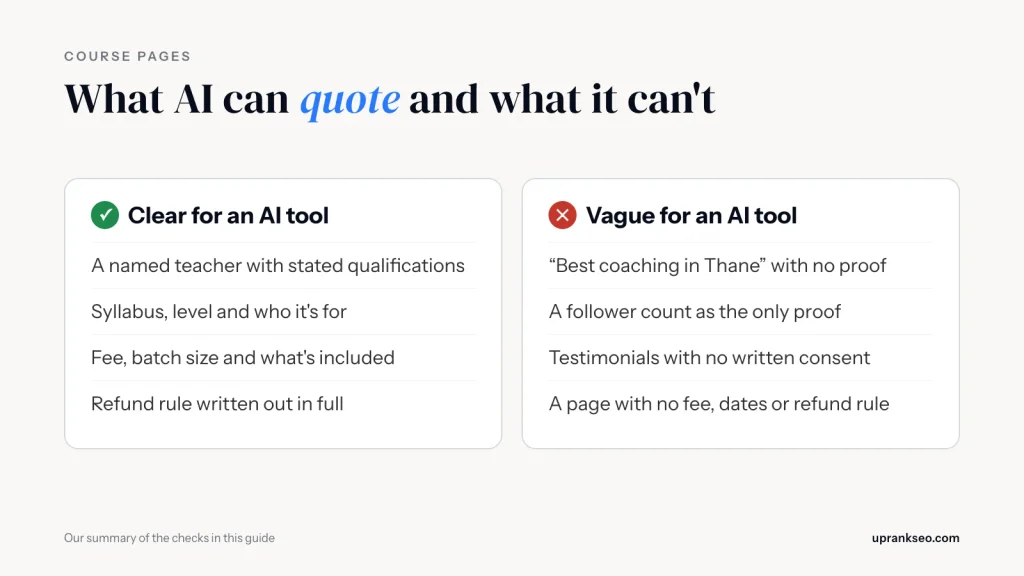
Open each page with two plain lines: what the course is and who it’s for. “Expert faculty with years of experience” gives an AI nothing to repeat. A page that names the teacher, states the batch size, shows the fee and spells out the refund rule does.
Do reviews and mentions count?
Reviews still help. Honest reviews from real students, on Google, on your YouTube channel or on your course platform, give an AI tool something to check against your claims. Reply to each one politely. Don’t write reviews yourself, don’t buy them, and don’t post a student’s praise if they never took the course.
Mentions matter as well. A webinar listed on the organiser’s site, a podcast interview with show notes, a guest article on a site in your subject, or a listing with a professional body or training network are all pages you don’t control. Each one confirms who you are. If you also teach from a centre, the guide on getting ChatGPT, Gemini and Claude to recommend your coaching classes covers that side of the work.
Endorsements need more care. If an affiliate or influencer promotes your course, the CCPA’s 2022 guidelines on misleading advertisements and endorsements say an endorsement must reflect a genuine, reasonably current opinion, based on adequate information about or experience with the product. They also require any connection that could affect how much weight people give the endorsement, and that the audience wouldn’t expect, to be fully disclosed. A commission is the obvious connection to disclose, so put the disclosure on the post itself.
What rules apply to coaching ads?
The CCPA’s Guidelines for Prevention of Misleading Advertisement in Coaching Sector, 2024, dated 13 November 2024, say they apply to all forms of advertisements by any person engaged in the coaching sector, including an endorser. They bar false claims about the credentials of faculty, about fees, and about the course exit policy, including fee refunds. If you use a successful candidate’s name, photograph, testimonial or video, you need their written consent. The official list of CCPA guidelines is on the CCPA website.
The text doesn’t say whether a one-person online programme counts as the coaching sector, so ask a lawyer before you decide it doesn’t. Until then, treat every course page as an advertisement and keep each claim provable.
How do you check whether AI recommends you?
Test it once a month. Open ChatGPT, Gemini, Claude and Grok in fresh chats and ask what your students ask:
- “Which online maths tutor for Class 10 CBSE in Thane has weekly tests?”
- “Who teaches spoken English online to working professionals in Mumbai?”
- “Where can I learn Excel online for a small shop in Navi Mumbai?”
- “Which online yoga teacher in Pune takes private sessions?”
Write down whether you’re named, where you appear and which pages each tool cites. Those cited pages show where to add the next mention.
What can you expect, and how soon?
One of our case studies is an IIT-JEE maths coach in Hiranandani Estate, Thane. Over 90 days, its keywords in the top 3 went from 0 to 17 of 26, monthly impressions rose from 102 to 902, and its Google Maps ranking moved from #4 to #2. Those are Google Search results, not AI answers, so read them as a sign of where to start rather than proof of AI visibility.
Google rankings take months to move. OpenAI says changes to robots.txt for its search crawler can take about 24 hours to apply, and sites opted out of OAI-SearchBot won’t show in ChatGPT search answers. So check that your robots.txt isn’t blocking OAI-SearchBot or Googlebot. Google says AI Overviews and AI Mode need no additional requirements to appear, so normal indexing comes first.
If you want help with the technical side, our AI SEO service covers the pages, and local SEO covers listings for coaches who also teach from a centre.
Frequently asked questions
Do I need a separate AI strategy for my courses? Mostly not. Google says AI Overviews and AI Mode need no additional requirements, so sound search basics cover much of it. The extra work is making sure your pages, profiles and outside mentions all tell the same story.
Is a YouTube channel enough for AI to recommend me? Not on its own. A channel helps when it links to a clear About page and course pages that carry the same facts. A channel with no links leaves an AI tool guessing who you are.
Can I use student testimonials on my course page? Only genuine ones. Before you use a successful candidate’s name, photo, testimonial or video, get their written consent, as the 2024 coaching guidelines require. Ask a lawyer whether that rule reaches your course.
Do affiliates have to say they’re paid? Yes, if the commission is a connection that could affect how much weight their audience gives the post. The 2022 endorsement guidelines require that connection to be fully disclosed, so make the disclosure clear and easy to see.
Should I add Person markup to my About page? It helps if it matches what’s on the page and lists your real profiles with sameAs. Schema.org says sameAs should point to a URL that unambiguously indicates the item’s identity, such as your official website. Markup supports clear content; it doesn’t replace it.
How do I know whether AI tools are recommending my course? Ask ChatGPT, Gemini, Claude and Grok the same questions once a month, in fresh chats. Log who gets named and which pages they cite, because those pages show what to improve next.
Find out what AI says about your courses
We’ll ask ChatGPT, Gemini, Claude and Grok the questions your students ask, show you who gets named and tell you what’s holding you back. It’s free. Request your AI visibility check.