
When a client asks ChatGPT, Gemini, Claude or Grok whether an adviser is trustworthy, the tool looks for proof it can check. For a financial adviser, that means a SEBI registration number the client can look up, qualifications that match the name on the page, a valid ARN if you distribute funds, and reviews and mentions that agree with all of it. Keep ad claims within SEBI’s rules.
This guide takes the proof points one at a time, starting with the ones a client can check for free. If you want the wider picture first, read our guide for financial advisers on AI recommendations. Where a rule is changing, we say so.
What does an AI tool check before it names an adviser?
There’s no approved list of trust signals, and no AI company publishes one. What works is what you’d expect from any careful buyer. A claim is easier to rely on when another person can check it in a few minutes, and that’s the test we’d apply to your site.
| Trust signal | The question behind it | What to publish |
|---|---|---|
| Registration | Is this adviser on SEBI’s list? | Your SEBI registration number and category on the homepage and every service page |
| Qualifications | Do the named people hold the certificates they claim? | Each adviser’s name, the NISM certificates they hold and their expiry dates |
| Distribution number | Is the ARN valid? | Your ARN if you distribute mutual funds, and the firm name it’s registered under |
| Reviews | Do real clients describe the same service? | Genuine Google reviews, each one answered politely |
| Mentions | Does anyone independent confirm you do this work? | Professional body listings, press quotes and event talks that name your firm |
| Ratings | Did an independent agency rank you? | Only ratings from a verification agency, with its name and the date |

Which registration numbers belong on your site?
Start with the check a client can do for free. The guide to checking an adviser’s SEBI registration says to look on SEBI’s website, where a current list of registered advisers is kept. A genuine adviser should be able to produce its certificate of registration whenever it’s asked for, and a lapsed or cancelled registration is a reason to walk away.
So put your registration number and category on the homepage and every service page, in the same format each time. Check it against the list character by character. A single wrong digit is the quickest way to lose a careful reader, and the same number needs to appear on Justdial, LinkedIn and anywhere else you’re listed.
If you distribute mutual funds instead of giving advice, your ARN is the number to show, and it has its own trap. AMFI publishes a list of ARNs it has declared invalid. Those are distributors whose firm names still carried adviser-type terms without the required name change. AMCs have stopped accepting business from them for some time, so check your status before you describe your firm in any other way.
Do the people on your site have checkable qualifications?
Individual advisers and principal officers of advisory firms must pass both NISM Series X-A and Series X-B. Persons associated with investment advice have to pass both levels as well. NISM puts the pass mark at 60% and says the certificate is valid for three years.
That makes certificate dates a trust signal in their own right. Write down when each adviser’s certificate was issued and when it expires, and update the page before the renewal date, not after. A page that names a lapsed certificate is easy for a client to spot, and it does your credibility no good.
List qualifications by name, the body that issued them and the year. Leave out any title you can’t back with a certificate. A line such as “certified wealth expert” gives a reader nothing to check, and an AI tool has nothing specific to repeat. Give each adviser a short bio with the years they’ve practised and the areas they cover, such as retirement planning for families in Thane or tax on mutual fund gains in Navi Mumbai.
Do reviews still help, and can you use them in ads?
Reviews on your Google Business Profile still count for local visibility. Google says that “more reviews and positive ratings can help your business’s local ranking”. It also says that “businesses with complete and accurate info are more likely to show up in local search results”, so keep the profile complete as well as collecting reviews.
Google adds that “when you reply to customer reviews, it shows that you value their feedback”. Keep replies short and general. Never confirm anything about a client’s investments or returns, even to say thank you.
The catch is the advertising code. Once it applies, the code prohibits testimonials in advertisements. A review sitting on your Google profile is one thing. Lifting a client’s quote onto your homepage, a LinkedIn post or a brochure is another. Keep the two apart until your compliance adviser has signed off on how you use reviews in marketing.
Can a rating or ranking help?
Yes, but only one kind. The Common Advertisement Code allows ratings and rankings assigned by a Past Risk and Return Verification Agency to be advertised. That’s the test for any rating you show: name the agency, date the rating and keep its wording. A rating you gave yourself doesn’t pass that test.
Return figures need care too. The same code does not repeal the rule against misleading past-performance presentation, so have your compliance adviser check any return figure before it goes on a page.
What can’t the advertising code let you say?
SEBI notified the Common Advertisement Code recently, and it was published in the Official Gazette shortly after. It comes into force on the 180th day after publication, so check the current text for its start date. At the time of writing it isn’t in force yet. It covers investment advisers and research analysts.
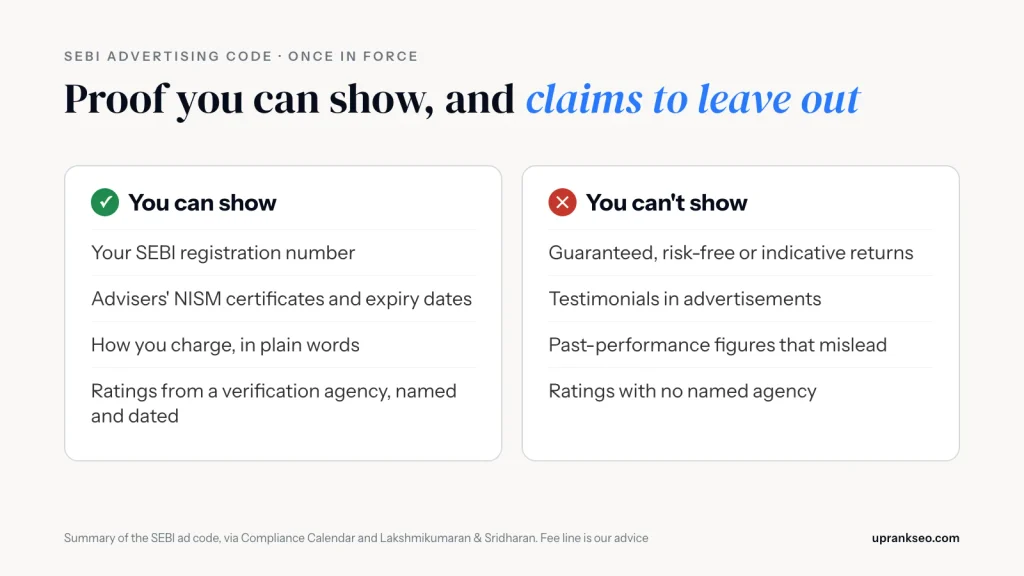
Two of the things it bars matter most for trust signals. Advertisements can’t assure investors of guaranteed, risk-free or indicative returns, and they can’t carry testimonials. Both points come from the Compliance Calendar summary of the code.
Until the code applies, the rules in force today still govern your ads. Ask your compliance adviser which ones cover each piece of marketing on the day you publish it.
Do mentions on other sites count?
Yes, and they do a different job from your own pages. A quote in a business paper, a talk at a college that gets written up, or a listing with a professional body gives a reader a second page to compare against. You don’t control those pages, which is exactly why they’re useful.
Start with what you already have. If you belong to a professional body, check that your listing matches your registration details. When an event organiser publishes a talk you gave, ask them to name your firm and your credentials correctly.
For the listings that cover each area you serve, our local SEO service does that work. Our AI SEO service covers how the pages themselves are built so AI tools can read them. Our guide on how AI tools decide which business to recommend explains why these outside mentions carry weight.
What results can an adviser realistically expect?
We haven’t done a case study for a financial adviser yet, so we won’t invent one. The closest we can point to is our case studies page, which covers other sectors and reports Google Search results, not AI answers.
Don’t expect trust signals to show up in AI answers within a week. Test the same questions every month, and change one signal at a time, so you can see what actually moved the answer.
How do you check whether AI recommends your practice?
Test it once a month in fresh chats with ChatGPT, Gemini, Claude and Grok. Ask the questions your clients actually ask:
- “Is there a SEBI-registered financial adviser in Thane with a clear fee page?”
- “How can I check if a financial adviser in Navi Mumbai is registered with SEBI?”
- “Which mutual fund distributors in Kalyan have a valid AMFI registration?”
- “Which advisers in Mumbai have NISM certification and show their registration number?”
The fee-page wording in the first question is our recommendation, not a SEBI rule. Note whether your firm is named, whether the answer quotes your registration number and whether that number is right. If a tool repeats an old or wrong number, fix the page it cites first.
Frequently asked questions
Does a SEBI registration number make AI tools recommend my firm? Not on its own. It gives the tools something checkable to repeat and gives clients a reason to trust you. The listings, reviews and mentions around it do most of the work.
Can I show client reviews on my website? Check first. The Common Advertisement Code prohibits testimonials in advertisements once it applies. Until then, ask your compliance adviser which rules cover a client quote on your homepage, and keep your replies to reviews short and general.
Do my staff need NISM certificates too? If they are persons associated with investment advice, yes. NISM says they must pass both Series X-A and Series X-B. Certificates are valid for three years, so keep a note of each expiry date.
Is a mutual fund distributor’s ARN a trust signal? Yes, if it’s valid. AMFI publishes a list of ARNs it has declared invalid, and AMCs have stopped accepting business from those distributors for some time. Check your status before you publish the number.
Is the new advertising code in force yet? Not yet, at the time of writing. SEBI notified it recently, and it comes into force on the 180th day after Gazette publication. Until then, check each ad against the rules in force on the day you publish it.
Find out what AI says about your practice
We’ll ask ChatGPT, Gemini, Claude and Grok the questions your clients ask, show you which advisers get named, and point out which trust signals are missing or don’t match. It’s free. Request your AI visibility check.