

To get AI tools to recommend your flats, build each project page so its facts are easy to read and check. Put the project name, locality, MahaRERA number, unit types and what the price covers in plain text, not only in a brochure PDF. Repeat those facts the same way on your listings and directories. Schema markup helps, but clear, consistent text does most of the work.
A buyer in Thane might type, “Which RERA registered 2 BHK near Majiwada is under ₹1.5 crore?” into ChatGPT, Gemini, Claude or Grok. The answer depends on which pages the tool could read, understand and trust. Most builder and broker sites fail that test. The homepage has a glossy banner, the project page says “premium living” and the price sits inside a PDF. This guide covers what each page should say, where schema fits and what MahaRERA expects you to show.
Why do AI tools prefer a clear project page to a brochure?
AI assistants answer buying questions the same way they answer most others. They search, read a handful of pages and quote the ones that state their facts plainly. A brochure gives them very little to work with. A PDF also lacks the headings, dates and page structure that help a reader find one answer among many.
Google’s own guidance points the same way. Its AI features documentation says a page must be indexed before it can be shown as a supporting link in AI Overviews or AI Mode, and that there are “no additional requirements to appear in AI Overviews or AI Mode”. So the job is ordinary good search work: a proper page for each project, real text and details a buyer can check. Our AI SEO work covers this in more depth, and our guide on how AI tools decide which business to recommend explains the wider mechanics.

What should a project page say in its first lines?
Open with two or three plain sentences that answer the first question a buyer asks. Name the project, the developer, the locality and the homes on offer. A line such as “[Project name] is a 2 and 3 BHK residential project in Kolshet, Thane, with possession due in [month and year]” gives an AI tool something it can lift almost word for word. That is the point.
After that, follow the order in which buyers check things. We’d suggest this:
- Where it is, with the nearest station and main road
- Unit types, with carpet area in square feet
- What the price covers, and what it leaves out
- The possession date and the current state of construction
- The MahaRERA project number, QR code and website link
- Amenities that are built, kept separate from those still planned
Give each point its own heading. A heading such as “What the price includes” matches the question a buyer types far better than a plain “Pricing”, and it helps a reader scanning the page on a phone.
Which details do buyers ask AI about?
Buyers ask about money, location, timing and whether the project is legal to buy. The table below shows what each question needs on the page.
| Buyer’s question | What the page should state |
|---|---|
| Is the project registered? | The MahaRERA project number, the QR code and a link to the MahaRERA website |
| What will it cost me? | Unit types, carpet area and a price range, with what’s included and what isn’t |
| How far is it from work or school? | The nearest station, main road and travel time, stated plainly |
| When can I move in? | Possession month and year, and how much of the building is complete |
| Is anything still available? | Units left by type, with the date the list was last checked |
| Who is selling it? | Your agency name, your agent registration number and a real office address |
Use the table as a checklist for every project you list. If you can’t fill a row with a fact you can check, say so on the page rather than leaving the row out. A visible gap reads as honest. A missing answer reads as something to hide.
Does schema markup help a listing page?
Schema.org has a type called RealEstateListing. It is a kind of web page that describes one or more real estate offers, which makes it a sensible fit for a project or listing page. Sale or lease terms go in a separate Offer, and the property itself can be described with its own type. Use these only where they match what a visitor can read.
That last point matters more than the markup itself. Google says you should not mark up content that isn’t visible to readers of the page, and that your structured data must be “a true representation of the page content”. If the markup says a flat has three bedrooms, the page has to say so too.
Google is also clear that its AI features need no special markup. Its AI features guide says “there’s also no special schema.org structured data that you need to add”. So treat schema as a way to make your details unambiguous. It can’t stand in for clear text, and a page with tidy markup and a vague description still reads badly to a buyer.
What do the MahaRERA rules mean for your listing pages?
Two rules matter most here. The first is about who may sell. Every real estate agent in Maharashtra has to register with MahaRERA before dealing in a RERA-registered project, and MahaRERA’s guidance for agents cites Section 9 of the RERA Act and Rule 11 for this. If your listing page shows a project you sell, it should also show your own registration number.
The second rule is about what an advertisement must display. MahaRERA’s advertising circular requires the project’s registration number, a project QR code and the regulator’s website address to appear prominently in real estate advertisements. As Free Press Journal reported it, the details must be at least as large as the contact information and use a distinct colour. The report says the rule covers social media and messaging apps too, with fines of up to ₹50,000 for breaches. The circular applies to agents as well as developers, and it covers all real estate advertisements, so treat your listing pages the same way.
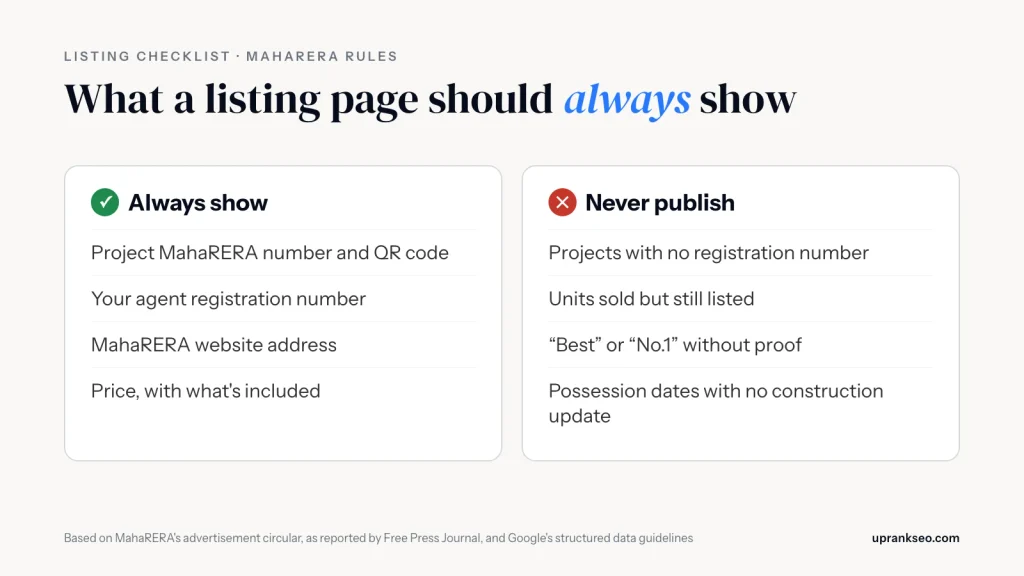
Put the same numbers in the same places on every listing. Have your legal adviser confirm the current order before you rely on these details, because a news summary is not the official text.
How do you keep listings from going stale?
A stale listing is a trust problem. If a page says “3 units left” and was last touched in the spring, an AI tool has little reason to quote it, and a buyer who calls is disappointed. Put a “last updated” date on each project page and on the availability table. Update the page when a unit sells, when a price changes or when a possession date moves. Take sold units off the list rather than leaving them up.
Check your robots.txt as well. OpenAI says that “sites that are opted out of OAI-SearchBot will not be shown in ChatGPT search answers”, and that a robots.txt change can take about 24 hours to apply. A listing page the crawler can’t reach won’t be quoted, however good it is.
Does this structure work in practice?
It does, though the results are Google’s, not an AI tool’s. One of our clients is a RERA-registered consultancy in Hiranandani Estate, Thane. Over a few months it moved from 3 keywords in the top five to 17, and all 19 tracked keywords reached page one. Monthly impressions rose from 669 to 1,359, and the search “real estate agent near me” went from #2 to #1.
Those are Google Search results, not AI answers. They matter here because the same clear, dated, checkable pages help both. Local listing work, including your Google Business Profile, sits within our local SEO service.
How do you check whether AI recommends your listings?
Once a month, open fresh chats in ChatGPT, Gemini, Claude and Grok and type the questions a buyer would type. Note which agents and projects get named, and which pages each tool cites. Those cited pages tell you what to fix first. Try questions like these:
- “Which RERA registered 2 BHK flats near Majiwada are under ₹1.5 crore?”
- “Which new projects near Thane station will be ready to move into soon?”
- “Which builders in Navi Mumbai show a clear price list for each flat type?”
- “Who in Thane can show me current listings with RERA numbers?”
Run the same four questions every month. A single answer can drift, so a pattern across several months tells you far more.
Frequently asked questions
Do I need a separate page for every flat? Usually no. One page per project, with a clear table of unit types and availability, covers most buyer questions. Give a project its own page whenever its location, possession date or RERA registration differs from your other projects.
Can I keep the brochure PDF? Yes, keep it for download. Put the price, location and RERA number in text on the page itself, because a PDF gives an AI tool very little to quote.
Does schema markup replace good content? No. Google says its AI features need no special structured data, and the markup must match what visitors see. Schema makes your details clearer to machines, but it can’t stand in for them.
Which registration number should a listing page show? Show the project’s MahaRERA registration number, its QR code and the MahaRERA website address, as the advertising circular requires for advertisements. Your own agent registration number belongs there as well. Confirm the current order with your legal adviser before you publish.
Should I publish prices? Where you can, yes, with what’s included and what isn’t. A price with no date or scope is hard for a buyer to check.
How often should listing pages be updated? Each time a unit sells, a price changes or a possession date moves. A visible “last updated” date lets a buyer, and an AI tool, see how current the page is.
Find out whether AI sends buyers to your listings
We’ll ask ChatGPT, Gemini, Claude and Grok the questions your buyers type, show you which projects and agents get named, and tell you which pages to fix first. It’s free. Request your AI visibility check.