An AI tool trusts a results page when every number on it can be checked: the exam, the year, how many sat it, how many were selected and whose name sits beside a result. Vague lines like “our toppers are the best” give ChatGPT, Gemini, Claude and Grok nothing to repeat. The CCPA’s 2024 coaching guidelines treat false selection claims as misleading advertising, so build the honest page.
This guide covers what a results page needs to show, which claims the guidelines rule out, how to feature a topper without breaking the consent rule, and how to test whether AI tools repeat what you publish.
Why do parents ask AI about results before they enrol?
A Class 12 student in Kalyan who wants a NEET seat rarely starts with a list of institutes. A parent types something closer to “Which NEET coaching in Kalyan has good results and small batches?” The tool searches, reads a handful of pages and names the institutes whose pages describe their results in a way it can repeat. Our guide on how AI tools decide which business to recommend explains that process in general.
Results are the first thing parents look for, which is also why they get inflated. Enrolment means a year of fees and a child’s year of study, so parents weigh every line. A page that shows one clear result with its context gives them something to compare. A page that promises “top ranks every year” makes them wonder what it actually means.

What does an AI tool look for on a results page?
It can’t verify your results on its own, so it looks for signs that a claim has a basis. A careful parent looks for the same signs.
| What the AI checks | What your results page should show |
|---|---|
| Which exam, and which year? | The exam name, the year and the batch, written out in full |
| How many students did the course? | The number who enrolled and sat the exam, so any rate has a base |
| How many were selected? | The count, with the official list of the exam body as the reference where one exists |
| Is a named student real and consenting? | Name and rank only with written consent, plus course length and whether it was paid |
| Does it match elsewhere? | The same figures on your site, your Google Business Profile and your brochure |
| Is it current? | A “last checked” date, and a fresh check each year |
A figure with no base, such as “Hundreds selected”, is the one a careful reader distrusts. An AI tool has no way to check it either, so it has no reason to repeat it.
Which result claims does the CCPA guideline rule out?
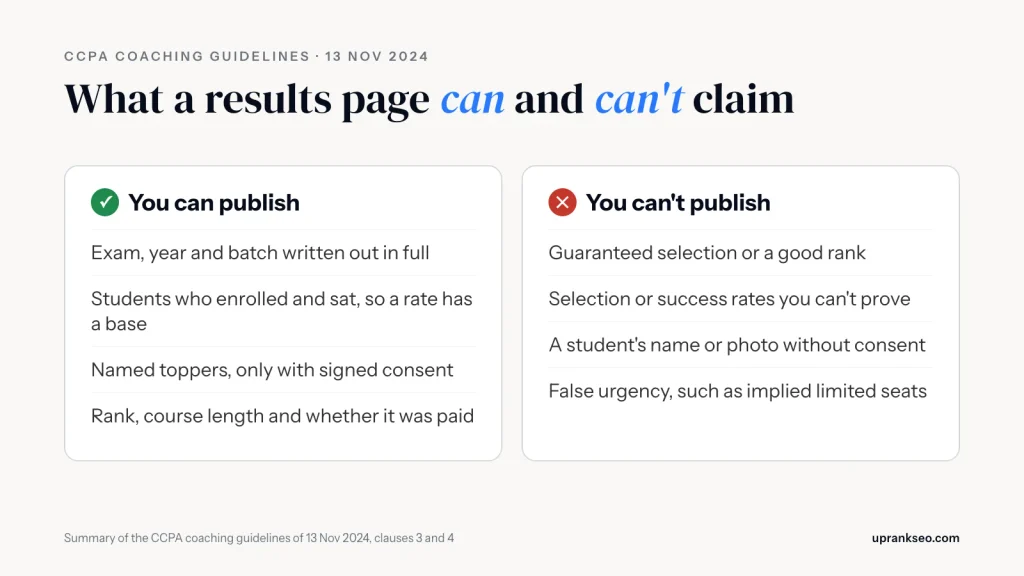
The Central Consumer Protection Authority issued the Guidelines for Prevention of Misleading Advertisement in Coaching Sector, 2024, on 13 November 2024. The notification, as hosted by LiveLaw, is short enough to read in one sitting. Five parts matter most for results pages:
- False claims about the number of selections, the rank in an exam or the success rate (clause 3(b)).
- Guaranteed selection, job security, or anything that leads a parent to believe enrolment “will ensure a good rank, high marks” (clause 3(c)).
- Falsely stating or implying urgency or scarcity, such as limited seats (clause 3(e)).
- When a student’s photograph appears, the rank secured, the course name and duration, and whether the course was paid (clause 4(1)(a)).
- Disclaimers and other important information, in the same font as the claim they qualify (clause 4(1)(b)).
The guidelines define a coaching centre as one teaching more than fifty students. Clause 3 is worded for anyone who provides coaching, though, so a small online tutor should read it as applying to them too. Ask your legal adviser to confirm that reading before you rely on it.
How do you feature a topper without breaking the consent rule?
Clause 4(2) says no one may use a successful candidate’s name, photograph, testimonial or video in an advertisement without that candidate’s written consent. The consent has to be taken after the selection. That timing matters. You can’t collect consent at admission for future marketing, because the result doesn’t exist yet.
In practice, that means four things:
- Ask for consent once the result is out, in writing, and name the page or channel where the name and photo will appear.
- Keep the signed form with its date on file.
- Show the rank, the course name, the duration and whether the course was paid, right next to the name.
- Put the disclaimer in the same font as the claim it qualifies, not in a footnote in small print.
Take a hypothetical case. A student secures a rank in a state entrance exam after a two-year course, and the course was paid. The page should give the exam, the year, the rank, the course length and that it was paid, with the signed consent on file.
Be careful about averages too. A selection rate worked out from your three best students is a claim a regulator could call false under clause 3(b). Publish the whole batch figure next to any top-result figure, so the reader can see both.
What should a results page contain?
Build the page in this order, so each figure has its context before the next one appears:
- The exam, the year and the batch, in plain words.
- Everyone who enrolled and sat the exam, then the number selected and the rate worked out from that base.
- Named results, but only with consent, and always with rank, course and duration.
- The fee and refund rule on the same page, so the results don’t stand apart from the price.
- A date and a note of when the figures were last checked.
Do AI tools need anything special for a results page?
No. Google says its AI features need no special work: “There are no additional requirements to appear in AI Overviews or AI Mode, nor other special optimizations necessary.” The page still has to be indexed and eligible to show in Google Search with a snippet, because that is how it becomes a supporting link.
ChatGPT uses its own crawler, OAI-SearchBot. OpenAI says sites that are opted out of it “will not be shown in ChatGPT search answers”. Check that your robots.txt doesn’t block it, and expect about a day for a change to reach OpenAI’s search systems.
If you add structured data, it must describe what visitors can see. Google’s guidelines say “Your structured data must be a true representation of the page content”, and they warn against markup for content that is “irrelevant or misleading”. Don’t add review or rating markup to a results page unless the reviews come from real users, because Google says ratings not by actual users may result in manual action.
Your Google Business Profile should carry the same facts. Google says “businesses with complete and accurate info are more likely to show up in local search results”, and “there’s no way to request or pay for a better local ranking on Google”. Our local SEO service handles the listing checks, and our AI SEO service can review your results pages against these rules.
What does local visibility look like in numbers?
One of our clients is an IIT-JEE maths coach in Hiranandani Estate, Thane. Over 90 days, its keywords in the top three Google results went from 0 to 17 out of 26, its monthly impressions rose from 102 to 902, and its Google Maps ranking moved from #4 to #2. It also reached #1 in Majiwada, Naupada and Lower Parel searches.
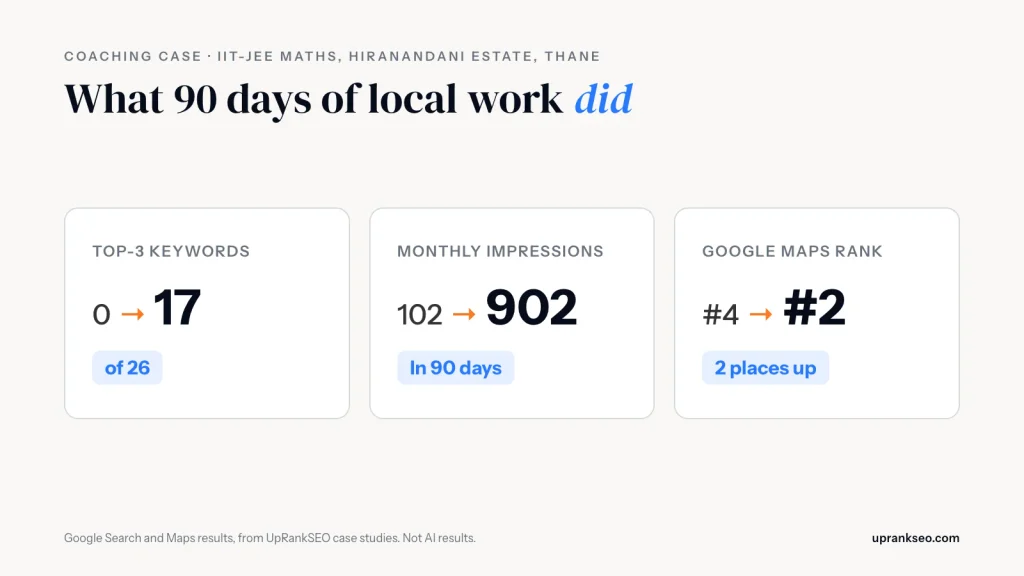
Local visibility results for a coaching class in Thane
Alt text: IIT-JEE maths coach results over 90 days: top-three keywords, monthly impressions and Google Maps rank
These are Google Search and Maps results, not AI answers, so read them as local visibility. They matter here because an AI tool can only name a page it can find, and Google’s own guidance says a page has to be indexed and eligible to show in search before it can appear as a supporting link in AI Overviews or AI Mode. The case study has the detail.
How do you check whether AI recommends your coaching institute?
Once a month, open fresh chats in ChatGPT, Gemini, Claude and Grok and ask what a parent would ask:
- “Which coaching class in Thane shows its IIT-JEE results with the batch size?”
- “Is there a NEET coaching in Kalyan that explains how its selection figures are counted?”
- “Which Class 10 CBSE maths tuition in Navi Mumbai publishes its results with dates?”
- “Which spoken English class for school students in Mumbai shows its fees and results clearly?”
Write down which institutes get named, whether a results page is cited, and whether the figures quoted match what you publish. If a tool repeats a number you never published, fix the page where that number lives, and find out where it came from.
Frequently asked questions
Can we show our toppers’ photos on the website? Only with the student’s written consent, and that consent has to be taken after the result. The page should also show the rank, the course name, the duration and whether the course was paid.
Can we write “100% selection” or “every student gets a top rank”? No. Clause 3 of the guidelines bars false claims about selections, ranks and success rates, along with guaranteed selection. Show a figure you can prove, and say which group it covers.
Do the rules apply to a small online tutor with 20 students? The guidelines define a coaching centre as one teaching more than fifty students, but clause 3 applies to anyone who provides coaching. Treat the rules as applying to you, and have your legal adviser confirm.
Do AI tools need a special results markup? No. Google says its AI features need no special optimisation. If you use structured data, it must describe what is visible on the page.
Can parents’ ratings go on the results page? Only genuine ratings from real users. Google says ratings not given by actual users may lead to manual action.
What if a result changes after we publish it? Date the page, correct the figure and remove anything you can no longer prove. An old result that is still online is still a claim.
Find out what AI says about your results
We’ll ask ChatGPT, Gemini, Claude and Grok the questions parents ask, check which results pages they cite, and list the claims that need changing. It’s free, and you can request your AI visibility check.