Schema markup is a short block of code that labels facts on your page: your clinic’s name, address, phone, opening hours and doctors. It gives machines a labelled copy of what the page already says. On its own, it won’t get ChatGPT or Gemini to recommend you, since Google says its AI features need no special schema. It’s still worth adding, as long as the code matches the page.
This guide covers which schema types fit a dental clinic, what to put in them, what to keep out and how to test the result. It builds on our guide to getting dental clinics recommended by AI and our explainer on how AI tools decide which business to recommend.
Does schema markup help AI tools find a dental clinic?
The honest answer is that the evidence is thin. Google’s guide on AI features and your website puts it plainly: “There’s also no special schema.org structured data that you need to add.” That’s a statement about what’s required, not a verdict on whether markup helps.
The most direct test we found is an Ahrefs study from May 2026. It tracked 1,885 pages that added JSON-LD schema between August 2025 and March 2026, and compared them with 4,000 pages that didn’t. Adding schema didn’t boost citations on Google AI Overviews, AI Mode or ChatGPT. The one statistically significant result was a 4.6% drop on Google AI Overviews, while AI Mode (+2.4%) and ChatGPT (+2.2%) were too small to tell from zero. The study looked only at pages AI tools already cited, so it can’t rule out schema helping a page get noticed in the first place.
Bing sounds more positive. In March 2025, Search Engine Roundtable reported that a Bing product manager had said at SMX Munich that schema helps Microsoft’s language models understand a page. That was a conference remark, passed on from a LinkedIn post, not a published rule. Treat it as a hint.
So think of schema as clarity. It labels your facts so any machine reading the page can match them without guessing, and it costs very little to add. It won’t do the work of a good treatment page or consistent listings.

Which schema types fit a dental clinic?
Schema.org has a type called Dentist. It sits under LocalBusiness and MedicalBusiness, so it describes your clinic as a place. Google’s local business guide asks for the most specific LocalBusiness subtype that fits, which makes Dentist a better choice than a generic business entry.
Doctors are harder to label. Schema.org’s Physician type is described as “an individual physician or a physician’s office”, and it has a medicalSpecialty property for speciality. It’s defined for physicians, so ask your developer whether it’s the right fit for a dentist before you use it. Whichever type you pick, each doctor’s name, qualifications and registration number should appear as plain text on that doctor’s page.
What goes in the markup, and where does it show?
Google requires only two properties for a local business, name and address. The others are recommended. This table lists the ones that matter most for a dental clinic, and where a patient should be able to see each value.
| Property | What to enter | Where a patient sees it |
|---|---|---|
| name and address | Clinic name and postal address, exactly as on your Google Business Profile | Footer and contact page |
| telephone | The number with country and area code | Contact page and header |
| openingHoursSpecification | Each day’s opening and closing times, in hh:mm:ss format | The timings block on the contact page |
| url | Your main web address | Every page, in the header or footer |
| geo | Latitude and longitude to at least five decimal places | The map on the contact page |
| department | Each separate department your clinic runs, such as orthodontics or paediatric dentistry | The matching treatment or department page |
Every value in the code should appear on the page. Google’s structured data policies say that “your structured data must be a true representation of the page content,” and that you shouldn’t mark up “content that is not visible to readers of the page.” The same policies say Google “does not guarantee that your structured data will show up in search results”. The markup is a label, and the page still has to earn the result.
How do you add schema without breaking the site?
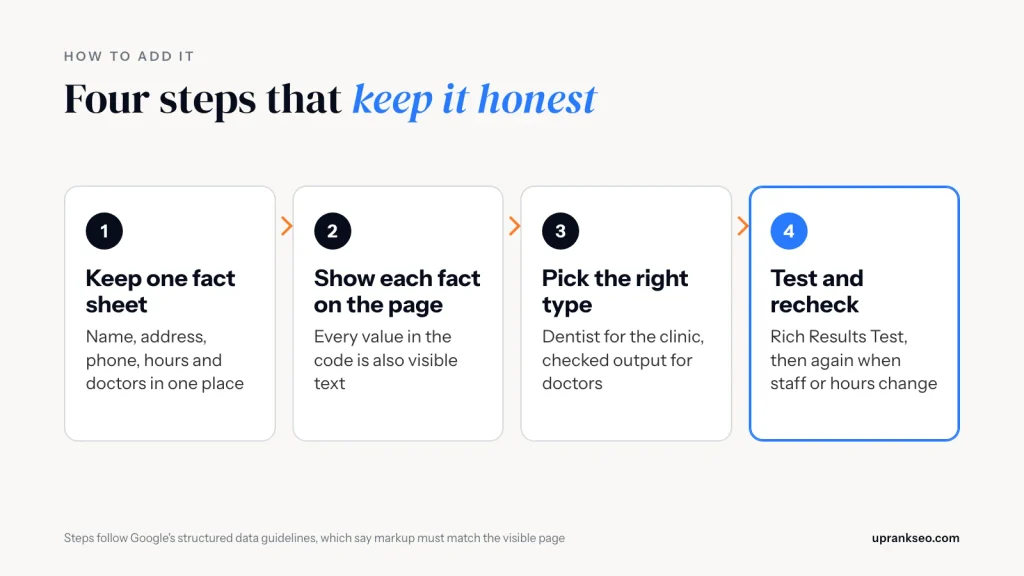
Work through these in order. The first two matter more than the code.
Start with one fact sheet. Write down the clinic’s name, address, phone, hours and each doctor’s details in one place, then copy that sheet onto your Google Business Profile, Justdial, Practo and your website. If your listings already disagree, fix them first, because markup can only repeat what’s in the sheet.
Next, make each fact visible. The timings should sit in a block a patient can read, the address belongs in the footer, and each doctor’s name should appear on that doctor’s own page. If you’d rather hand the listing side to someone else, our local SEO service covers it.
Then add the code. A developer can write it by hand. If your site runs on WordPress or a website builder, check whether a theme or plugin adds LocalBusiness markup, and read what it outputs rather than trusting the default. Confirm the output names the Dentist type and carries the same hours and phone number as the page. If you want an outside check of the markup and the pages together, our AI SEO service covers that.
Finally, test and recheck. Google’s Rich Results Test says to “Test your publicly accessible page to see which rich results can be generated by the structured data it contains.” Fix every error it reports. Then look at the code again whenever a doctor joins or leaves, when timings change for a festival week, and after any site redesign. Old code that still names a doctor who has left creates the same mismatch that confuses listings.
What should stay out of your markup?
Reviews are the trap. Google’s review snippet guidelines say that when a business controls its own reviews, pages that use LocalBusiness or Organization structured data aren’t eligible for the star review feature. The example they give is a review about a business placed on that business’s own website, and that includes embedded third-party widgets such as Google Business reviews. The same page says that ratings “must be sourced directly from users.”
The National Dental Commission adds a second reason. Its Ethics and Dental Registration Board issued an advisory on 14 October 2026, as Medical Dialogues reported. It flags publishing patient testimonials and before-and-after photographs. The report doesn’t mention websites or structured data, so the reading that the rule covers the content itself is ours. If a testimonial can’t appear on your page, don’t mark it up either, and check the exact wording with your legal adviser.
Keep claims out of the code too. The advisory also flags misleading treatment claims, so a description field that calls your clinic the “best” in Thane carries the same risk as the same words on your homepage. Leave out anything you can’t back up, and leave out anything that isn’t visible on the page.
How do you check whether AI recommends your clinic after the changes?
Run these four questions in fresh chats on ChatGPT, Gemini, Claude and Grok. Do it once before you change anything, and again about a month later:
- “Which dentist in Navi Mumbai does root canal treatment, and what are their qualifications?”
- “Which dental clinic near Thane station is open on Saturday evening?”
- “Who does paediatric dental check-ups in Kalyan?”
- “Which dentist in Santacruz West explains implant options in simple words?”
Check the details each answer gives, not just the clinic’s name. A wrong opening time or an old doctor’s name means one source is out of step: the page, the markup or a listing. Your fact sheet tells you which one to fix.
For a sense of scale, look at our paediatric surgeon case study, which covers a paediatric surgeon and paediatric urologist in Santacruz West, Mumbai. Between June and October 2026, the surgeon’s Google Maps ranking went from outside the top 10 to #3, and Google reviews rose from 9 to 25. The page lists condition-led pages, weekly Business Profile posts, a steady review programme and backlinks. Schema isn’t on that list, so we don’t credit markup for the change. These are Google results, not AI results.
Frequently asked questions
Do we need schema markup for AI tools? Not for Google’s AI features, which need no special schema. It’s still worth adding for a clinic, because it labels your name, address, hours and doctors clearly, as long as it matches the page.
Should we use the Dentist type or a general business type? Use the most specific type that fits. On schema.org, Dentist sits under LocalBusiness and MedicalBusiness, so it suits a dental clinic better than a generic entry. Have your developer check the output.
Can we show patient reviews in the markup? Not for reviews on your own website. Google says a business that controls its own reviews isn’t eligible for the star review feature, and the National Dental Commission’s October 2026 advisory flags patient testimonials. Leave reviews out of your code and your pages.
Will schema get our clinic into Google’s rich results? It might, but Google doesn’t guarantee it. Use the Rich Results Test to catch errors, and keep your Google Business Profile complete, since Google says complete and accurate information makes a business more likely to show up in local search results.
Does Bing read schema? A Bing product manager reportedly said in March 2025 that schema helps Microsoft’s language models understand pages. It was a conference remark, not a published rule, so treat it as a hint rather than a promise.
How often should we check the markup? Check it whenever a doctor joins or leaves, when your timings change and after any website update. Wrong hours in the code cause the same confusion as wrong hours on a listing, because both feed the same answer.
Find out what AI says about your clinic
We’ll ask ChatGPT, Gemini, Claude and Grok the questions your patients ask, check which clinic details they get right and list the ones that don’t match your pages. It’s free. Request your AI visibility check.