AI assistants such as ChatGPT, Gemini, Claude and Grok recommend the businesses they can find and check on the open web. Ask one for “a good dentist near Thane station” and it usually runs a quick web search, reads a few pages and names the clinics those pages describe clearly. So whether you get named depends on your website, your listings, your reviews and what other sites say about you.
Most business owners we speak to assume there is some secret list, or that big brands simply get picked. Neither is true. Once you see how these tools put an answer together, the fixes are fairly ordinary.
What actually happens when someone asks an AI tool for a recommendation?
Say a customer in Thane types, “Which dentist near Thane station is good for root canal treatment?”
The AI first decides whether it can answer from memory. For anything local, it usually can’t, because its training data is months old and doesn’t know which clinic opened last year. So it searches the web.
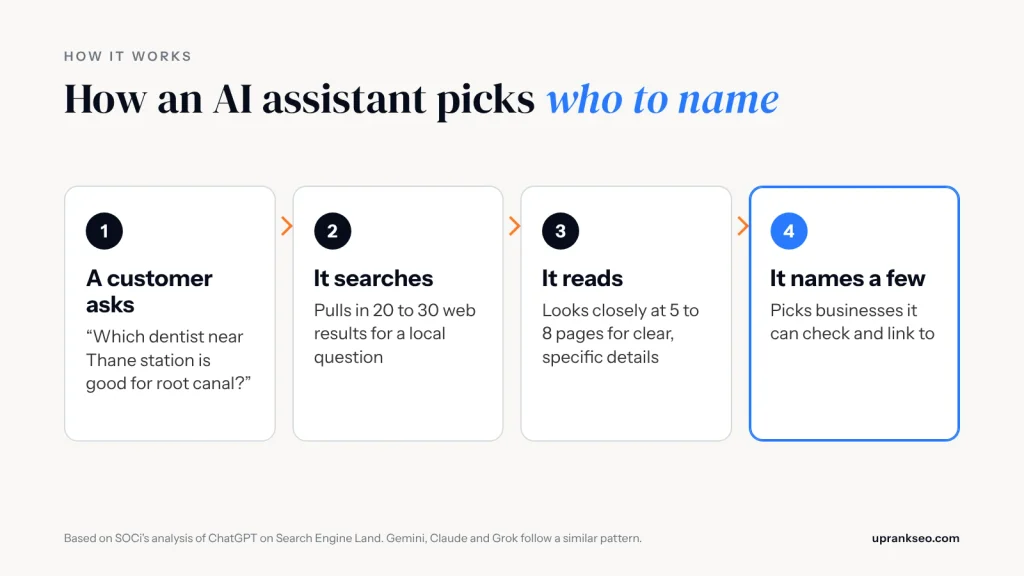
Researchers have watched this happen in ChatGPT. A SOCi analysis published on Search Engine Land found that ChatGPT pulls in roughly 20 to 30 search results, looks closely at 5 to 8 of them, and builds its answer from 3 to 5 sources it can verify and link to. Gemini, Claude and Grok work differently under the hood, but they follow the same broad pattern of search, read, then summarise.
The answer then names the businesses that came through clearly in those sources: what they do, where they are, what customers say and how to reach them. If your clinic isn’t on those pages, the AI has nothing to work with. If it’s there but described vaguely, a competitor with a clearer page gets the mention.
Where do these tools get their information?
From what’s published. None of the big AI companies keeps a private register of good businesses.
Each tool reads the web through its own search setup. Google’s Gemini and AI Overviews sit on top of Google Search. ChatGPT runs its own crawler, OAI-SearchBot, which OpenAI says “is used to surface websites in search results in ChatGPT’s search features”. For the search itself, independent tests suggest ChatGPT leans mostly on Bing’s index rather than Google’s.
The best public data on sources comes from BrightLocal’s study of 800 local searches in ChatGPT. It’s a US study, but the pattern is useful anywhere.
| What ChatGPT cited | Share of sources | What it means for you |
|---|---|---|
| Business websites | 58% (72% for “book” or “buy” searches) | Your own site matters more than anything else on this list |
| Mentions on other sites | 27% | News stories, association pages, “top 10” lists and local blogs |
| Directories | 15% | In India think Justdial, Sulekha, IndiaMART, Practo and trade directories |
Source: BrightLocal, November 2024, 800 searches across 20 US cities. The Indian directory examples are ours.
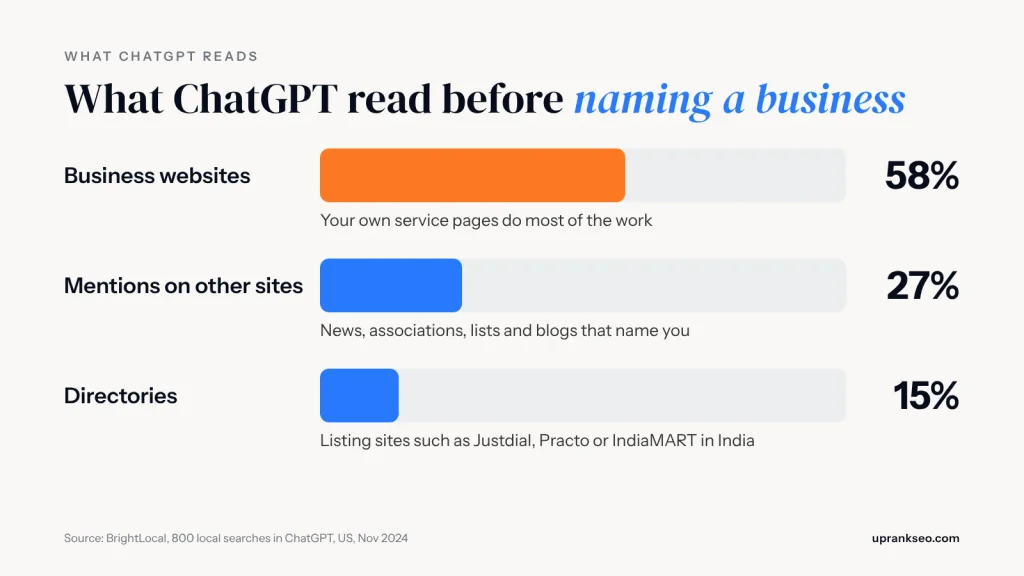
Two things stand out for Indian owners. Your website does far more work than you probably give it credit for. And a mention on someone else’s site, say a Mid-Day piece on a free dental camp you ran, can carry more weight than another post on your own blog.
Do Google reviews affect what AI tools recommend?
Yes, though the route depends on the tool.
For Gemini and Google’s AI Overviews it’s direct, because they use Google’s own data, Business Profile included. Google says plainly that “more reviews and positive ratings can help your business’s local ranking”.
For ChatGPT it’s more roundabout. The SOCi analysis found ChatGPT mostly quotes Google ratings when another page it reads mentions them. BrightLocal found it does draw on Google review information for local businesses. The evidence is mixed and keeps shifting as these products change.
In practice, it doesn’t matter much. Good reviews push you up Google, they get repeated on directories and blogs, and those are exactly the pages every AI tool reads. So keep earning them.
Why does AI recommend my competitor and not me?
When we look into this for a business, it usually comes down to one or more of these:
- The AI can’t reach your site. Your robots.txt blocks AI crawlers, or Bing has never indexed your pages.
- Your pages say very little. One “Our Services” page listing ten things gives an AI nothing specific to quote.
- Your details don’t match. The phone number on Justdial is different from the one on Google, or your old address still shows on Facebook.
- Nobody else talks about you. Your competitor shows up in a newspaper story, two directories and a local “best of” list. You only appear on your own site.
- Your reviews are thin or old. Eight reviews, the latest from 2023, suggests a quiet business.
- They answer questions and you only advertise. A page that explains cost, process and timelines gets quoted. A page that just says “Call us today” doesn’t.
None of this is a trick. It’s about being easy to find, easy to understand and consistent wherever you appear.
Do ChatGPT, Gemini and Claude recommend the same businesses?
Often they don’t. In an October 2026 field test by Ryan Doser, four AI assistants, including ChatGPT, Gemini and Claude, were asked the same local questions. Their first picks matched in only 6 of 72 comparisons, about 8%. And only about a fifth of their suggestions were in Google’s top three map results.
Answers also drift. When the same questions were asked again, roughly four out of five businesses came back.
So it’s a mistake to optimise for one tool. Work on the things they all read, and check several tools each month.
Is Google’s AI Overview any different?
A little. Google’s AI features run on top of normal Google Search, and Google says a page only needs to be “indexed and eligible to be shown in Google Search with a snippet”. There are “no additional technical requirements” and no special AI markup.
That means good SEO already covers most of Google’s AI. The extra work for ChatGPT and the others is showing up in Bing and on the third-party pages they trust.
| Google AI Overviews, AI Mode, Gemini | ChatGPT | |
|---|---|---|
| Main search source | Mostly Bing, going by independent tests | |
| Crawler to allow | Googlebot | OAI-SearchBot |
| Listing that matters most | Google Business Profile | Your website, directories and pages that mention you |
| Special AI optimisation | None needed, says Google | None official; clear, checkable pages do best |
What can you do this month?
You don’t need a big budget for any of this.
- Open your robots.txt (yoursite.com/robots.txt) and check it isn’t blocking Googlebot, Bingbot or OAI-SearchBot.
- Add your site to Bing Webmaster Tools. It’s free and takes ten minutes.
- Give every main service its own page. Start each one with two plain lines: what it is, who it’s for and how pricing works.
- Make your name, address and phone identical on your website, Google Business Profile, Bing Places, Justdial and social pages.
- Get mentioned elsewhere. Local news, your trade association, event listings and supplier websites all count.
- Ask happy customers for honest reviews and reply to every one. Never buy them.
- Each month, ask ChatGPT, Gemini, Claude and Grok the questions your customers ask, and note who gets named. Our 15-minute AI visibility check walks you through it.
How long before your business starts showing up?
Answers built from live search can change within a few weeks of your pages being indexed and ranking. OpenAI says robots.txt changes for its search crawler take about a day to apply.
What an AI “knows” without searching changes much more slowly, because models are retrained months apart. Mentions you earn this year shape those answers well into next year.
Our Local SEO plans include monthly tracking of AI discovery prompts, so you can see when your name starts to appear.
Frequently asked questions
Can I pay ChatGPT or Gemini to recommend my business? No. Their recommendations come from the pages they read. You can improve those pages and earn mentions, but there’s no paid spot in the answer.
Does ChatGPT use Google or Bing? Independent tests by BrightLocal and SOCi found ChatGPT’s web search relies mostly on Bing. Gemini and Google’s AI Overviews use Google Search.
Do I need a separate AI SEO strategy? Mostly not. Google says its AI features need no special optimisation. The extra effort for other AI tools is being visible in Bing and on trusted third-party sites.
Why does the same AI tool give different answers each time? Each answer comes from a fresh search and a fresh reading of the results. In one test, about four in five recommended businesses came back when the same question was repeated.
Does schema markup help with AI tools? It helps search engines read your details, and Google says it must match what visitors see on the page. It’s worth doing, but clear page content matters more.
Can a small local business beat a big brand in AI answers? Yes. For local questions, AI tools look for businesses that pages describe clearly in that area. A well-documented clinic in Thane can easily beat a national chain with a thin local page.
Find out what AI says about your business
We’ll ask ChatGPT, Gemini, Claude and Grok the questions your customers ask, show you who gets named, and tell you what’s holding you back. It’s free. Request your AI visibility check.