SEO is getting your pages found in Google. AEO (answer engine optimisation) is shaping those pages so they can be lifted into a direct answer. GEO (generative engine optimisation) is making sure AI tools such as ChatGPT, Gemini, Claude and Grok mention you when they write that answer. Google says its AI features still run on SEO, so you don’t need three separate projects.
The three labels cause a lot of confusion, partly because agencies sell them as separate packages. This guide explains what each term means, where it came from, what it asks you to do, and which parts a shop or clinic in Thane, Kalyan or Navi Mumbai should actually spend time on.
What is SEO, and does it still matter?
Search engine optimisation is the work of making your website easy for Google and Bing to find, read and rank. It covers your pages, how fast they load on a phone, your Google Business Profile, and the links and mentions that point back to you. When someone in Kalyan types “plumber near Kalyan station”, SEO decides whether your name appears in the map results, the normal blue links or both.
It still matters most. AI tools answering local questions often search the web first and then read a handful of pages. Our pillar guide on how AI tools pick a business walks through that step by step. The pages they read are usually the ones that are already easy to find and understand, so good SEO is the base the other two sit on.
What does AEO mean, and what does it ask of your website?
AEO stands for answer engine optimisation. Google’s own guide uses the same definition: “AEO” stands for “answer engine optimization” and “GEO” for “generative engine optimization”. The idea is simple. A customer asks a question and gets a direct answer, so your page needs the clear, specific sentence that answer can be built from.
Picture a tuition centre in Navi Mumbai that writes, “Our Class 10 maths batches have 12 students, meet on weekday evenings and cost ₹4,500 a month.” That gives an answer something to repeat. A line like “Quality education for every child” gives it nothing.

In practice, AEO means a plain answer at the top of each service page, a few real questions and answers at the bottom, and prices or timings written as text rather than tucked into a PDF or an image. Our AI SEO service handles this work for clients, but you can start with one page yourself.
What does GEO mean, and where did the term come from?
GEO is generative engine optimisation. The term comes from a research paper called “GEO: Generative Engine Optimization”, first posted to arXiv in November 2023 and accepted at KDD 2024. The authors set out ways for content creators to raise how often their pages appear in generative engine answers, and reported gains of up to 40% in their own tests. That figure comes from a 2023 preprint, so read it as a sign of direction, not a promise for your site.
GEO is really about the last step. By the time an AI tool writes its answer, it has already found several businesses and has to choose which ones to name. That choice is where GEO work lives: being specific, consistent and easy to check. Tools don’t always choose the same way, either. In an October 2026 field test by Ryan Doser, four AI assistants, including ChatGPT, Gemini and Claude, matched on their first pick in only 6 of 72 comparisons. So the sensible goal is to be easy to choose for all of them, not to win over one tool.
Are AEO and GEO just SEO with new names?
Mostly, yes. Google’s May 2026 guide to optimising for generative AI features says that “optimizing for generative AI search is optimizing for the search experience, and thus still SEO.” The same guide says you don’t need to create “new machine readable files, AI text files, markup, or Markdown” to appear in Google Search. Google’s May 2025 post on AI experiences makes the same point in other words: “The underpinnings of what Google has long advised carries across to these new experiences.”
So the honest answer is that the terms overlap. Agencies use them to sell separate packages, and some of the tactics sold under them have no backing from Google. The same guide warns that many suggested “hacks” aren’t effective or supported by how Google Search actually works. The table below shows how the three compare in practice.
| SEO | AEO | GEO | |
|---|---|---|---|
| Goal | Rank well and win clicks, calls and map views | Be the clear answer to a specific question | Be named or cited inside an AI-written answer |
| Where it shows | Blue links, map results, Google Business Profile | Direct answers and AI features on Google | Replies from ChatGPT, Gemini, Claude, Grok and similar tools |
| What you do | Fix pages, speed, listings and links | Write plain answers, FAQs and visible prices | Keep facts consistent across the pages AI tools read |
| How you check | Rankings, calls and enquiries | Your key questions in Google, checked by hand | A monthly test with the questions your customers ask |
This is our summary of the three terms, not an official definition.
What does this mean for a business in Kalyan, Thane or Navi Mumbai?
Local questions depend heavily on your details matching across the web. In a BrightLocal study of 800 local searches in ChatGPT, business websites made up 58% of the sources cited, mentions on other sites 27% and directories 15%. Those are American figures from November 2024, so use them as a direction, not a benchmark. They still say the same thing that matters here: your own site does most of the work, and listings and mentions do the rest.
Google’s May 2025 post asks businesses to keep their Business Profile information current, and that same profile drives your map results. Check that your name, address and phone match on your site, Google, Justdial, Sulekha and IndiaMART. If you serve several areas, our local SEO service covers listings, service pages and reviews together.
What should a small business do first?
Start with the basics that help all three. Check that your robots.txt file isn’t blocking the crawlers you want. OpenAI says its search crawler, OAI-SearchBot, is “used to surface websites in search results in ChatGPT’s search features”, and a robots.txt change can take about 24 hours to apply.
Then work through the four moves in the diagram below. None of them needs a new tool or a big budget.
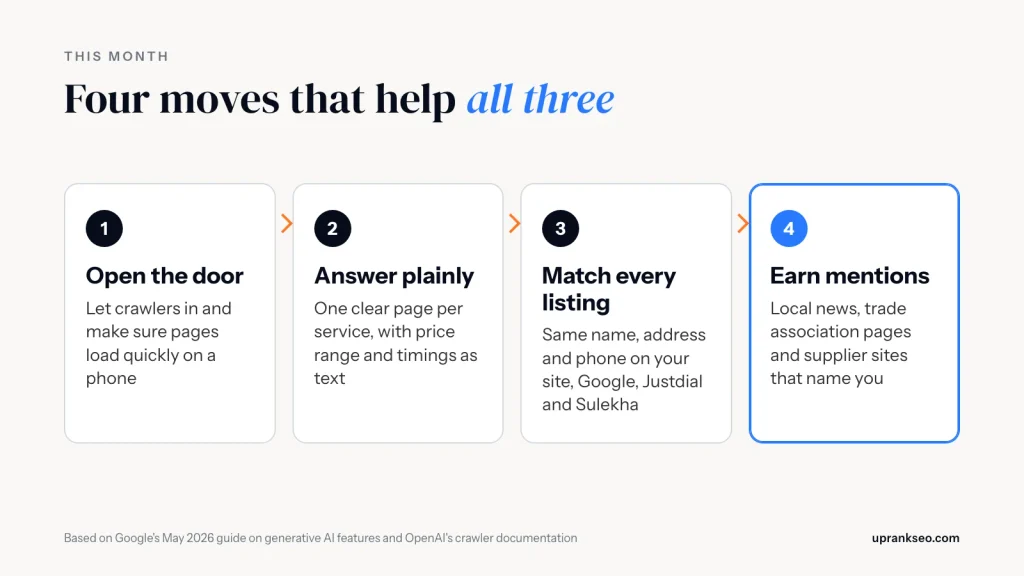
Pick one service this month and do steps two and three for it, then move to the next. Doing one service well beats a half-finished website.
Does this approach show results?
One of our clients is a produce exporter in Thane that sells to the USA. Its AI assistant referrals went from 0 to 43 a month, and 9 of its 14 US keywords reached the top three on Google. The referral figure is the only one here that comes from AI tools. The keyword count is from Google Search.
Results depend on your market and your competition, so treat this as a sign of what careful work can do, not a forecast.
How do you check whether AI recommends you?
Test once a month, in fresh chats, with the questions your customers would type. Ask ChatGPT, Gemini, Claude and Grok, then note who gets named:
- “Which plumber in Kalyan answers emergency calls at night?”
- “Best tuition centre for Class 10 maths in Navi Mumbai, and what does it cost?”
- “Which caterer in Thane does small house parties under 50 guests?”
- “Which chartered accountant in Mumbai handles GST for a small shop?”
Write down who is named, what each answer says about them and which pages it cites. Those cited pages tell you what to fix next.
Frequently asked questions
Do I need to pay for AEO and GEO as separate services? Probably not. Google says the best practices for SEO remain relevant to its AI features. Be cautious with anyone who sells AI-only tricks, because Google says many suggested hacks don’t work.
Do I need an llms.txt file or special AI markup? No. Google says you don’t need new machine readable files, AI text files, markup or Markdown to appear in Google Search.
Does schema markup help? It’s worth having, but Google says structured data isn’t required for generative AI search and there’s no special schema.org markup to add. Whatever markup you use must match what visitors see on the page.
Should I write differently for AI tools than for customers? No. Google says the advice it has long given still carries over to its AI experiences. Write for the customer who asked the question, in plain and specific words.
Is this only for big brands? No. Google’s guide puts unique, useful content first. A plumber who describes his own work in clear detail in Kalyan is doing exactly that, and a small firm with honest, specific pages can be a better answer than a national brand with a thin page.
Which AI tool should I focus on? None on its own. In the October 2026 Ryan Doser test, four AI assistants matched on their first pick in only 6 of 72 comparisons. Work on the pages and listings they all read, and check several tools each month.
Find out what AI says about your business
We’ll ask ChatGPT, Gemini, Claude and Grok the questions your customers ask, show you who gets named, and point to the pages to fix first. It’s free. Request your AI visibility check.