Yes, an eye hospital can publish health content that AI tools cite and still stay inside the NMC’s advertising rules. The guidelines issued on 6 October 2026 don’t stop doctors and hospitals from explaining conditions. They stop promotion dressed up as information: patient testimonials, before-and-after photos, claims you can’t prove, offers and fear-led posts. Write pages that teach, name the doctor, date them and leave out the sales pitch.
This guide sorts what you can publish from what you can’t, shows how to write a condition page that AI tools can quote, and covers what happens when a page crosses the line.
Why do AI tools need your health content at all?
When a patient in Kalyan asks ChatGPT what a retina problem involves or what recovery looks like, the answer usually comes from a page that explains it in plain words. A hospital with one thin Services page rarely gets quoted. A page that answers the question often does.
Google’s guidance is reassuring on the technical side. A page must be “indexed and eligible to be shown in Google Search with a snippet”, and Google says there are no additional requirements to appear in AI Overviews or AI Mode. The hard part is the writing. Our guide on how AI tools decide which business to recommend covers the wider picture.
What does the NMC allow on your website?
The guidelines issued on 6 October 2026 cover registered medical practitioners and hospitals alike. Medical Dialogues’ summary of the notice lists what’s permitted, and the list is more generous than many clinics expect. Hospitals can publish factual details about their name, location, departments, facilities, services, accreditation and charges. Charges are fine as long as they are “factual, transparent and not misleading”.
The doctor directory is the other big one. The guidelines treat a hospital website’s list of doctors, with names, recognised qualifications, specialities, registration details and availability, as patient information rather than paid promotion. Get that page right first, and keep the same facts consistent with your local SEO listings.
Educational content is the grey zone. Doctors may join awareness programmes and educational content, but the summary quotes the condition that this activity must “not promote personal practice, do not solicit patients and are not monetized through promotional marketing”. The summaries we read don’t say how a hospital’s own blog fits under that test. So treat every health article as a test: does it teach the patient something, or does it sell the hospital? If it’s the second, it doesn’t belong on your site, however accurate it is. Run any new series past your legal adviser before launch.
The same logic covers printed material. Doctors may hand health education pamphlets to their own patients, as long as they contain no guarantee of cure, no claim of superiority and nothing unsubstantiated. A leaflet in your waiting room is held to the same standard as a page on your website.
Where is the line between teaching and selling?
| Teaches the patient | Sells the hospital |
|---|---|
| Explains what a condition is, who it affects and the warning signs that need a doctor | “Best glaucoma screening in Thane, book today” |
| Describes a procedure, what happens on the day and how recovery goes | “Painless surgery with guaranteed clear vision” |
| States the risks and says what can’t be promised | “100% success rate” |
| Gives charges with what they include, and a date | “Limited-time discount on LASIK this month” |
| Names the doctor, qualifications and registration number | “Our renowned surgeon, the top eye doctor in Kalyan” |
| Uses an anonymised case for teaching, with consent | A patient’s before-and-after photo |
Most clinic owners can spot the right-hand column. The trouble is that one page can drift between the two columns in a single paragraph. Read each page through once with the hospital’s name covered up. If it still reads like an advert, rewrite it.
How do you write a condition page AI tools can quote?
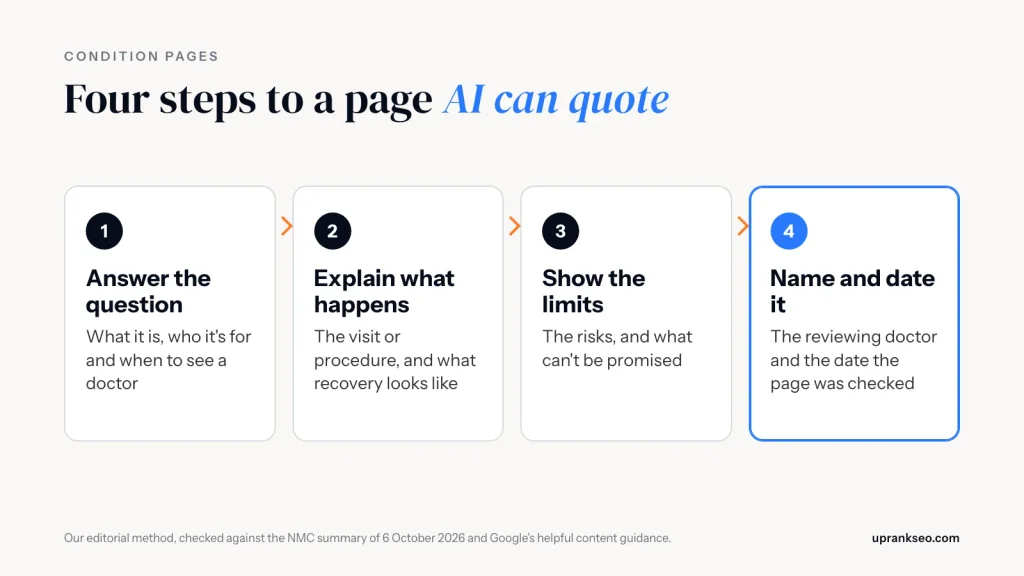
Start with the question the patient types, and answer it in the first two sentences. Then follow the same four steps on every condition page:
- Answer the question. What it is, who it’s for, and when to see a doctor.
- Explain what happens. The visit or procedure, and what recovery looks like.
- Show the limits. The risks, and what can’t be promised.
- Name and date it. The doctor who reviewed the page, and the date it was checked.
Medical facts need a doctor’s check before they go live. Name only the treatments your surgeons actually offer, and make sure the lens options or procedure names match what your consultation desk tells patients. Date the page honestly too. Google’s guidance warns against changing the date of pages to make them seem fresh when the content has not substantially changed, so update the date only when you update the page.
Name the doctor who wrote or reviewed each health page, with qualifications, registration number and specialities, and link to that doctor’s profile. Google asks whether content is “written or reviewed by an expert or enthusiast who demonstrably knows the topic well”. A named doctor answers that question on the page itself.
Google also encourages bylines where readers might expect one, and it discourages “fabricating creator profiles” with made-up names or false credentials. So no invented doctors, and no AI-generated headshots passed off as real people.
Be careful with photographs. The guidelines prohibit a doctor’s photo where it works as self-advertisement, so a portrait that sits next to a sales message is a problem even if the words are fine. Keep photos on the profile page and check the layout with your adviser.
What can’t go on the page, even with consent?
Several things are out whatever the patient agrees to:
- Patient testimonials and promotional patient stories. The summary is explicit that patient consent does not make a prohibited practice permissible.
- Before-and-after photos and publicised surgical results. Case publication is allowed only for scientific or educational purposes, with anonymised patient consent, and patient names, faces and identifying features need to be cropped or blurred.
- Superlatives you can’t prove. “Best doctors”, “No.1 Specialist”, “100% success” and “Guaranteed cures” are all out unless the claim can be objectively verified.
- Discounts, limited-time offers and free procedures where they are likely to encourage unnecessary treatment.
- Fear-based marketing and the promotion of unnecessary procedures.
- Fake, paid or manipulated reviews, ratings or followers, and manipulation of search rankings to create a false impression.
Can AI write your eye-care content?
AI can help with a first draft, and the guidelines accept AI-generated content that complies with them. Three conditions matter. The notice prohibits AI-generated promotional campaigns that serve commercial interest. Compliant AI content has to carry a clear source mark saying it came from AI. And AI can’t be used to create or alter a patient’s image, testimonial, voice or clinical outcome. Any patient data you feed into an AI tool has to follow privacy rules too.
Handing the work to an agency doesn’t move the responsibility. The guidelines say that publication through an agency, platform or influencer does not by itself absolve the doctor or hospital for content they authorised or knowingly permitted. Our own rule is simple: a doctor checks every medical fact before it goes live. Our AI SEO service covers the technical side of getting cited.
What happens if a page breaks the rules?
For doctors, enforcement runs through the State Medical Council, and the penalties climb with each violation. A first violation brings a warning and mandatory ethics training. A second brings censure and a monetary penalty. A third means suspension of registration for 3 to 6 months. Serious violations, such as misleading cure claims or patient inducement, can mean 6 to 12 months, and repeat violations can end in removal from the register for 1 to 3 years. Penalties need a show-cause notice and a reasoned order first. Hospitals fall under the Clinical Establishments Act or state law. The full penalty ladder is in the Medical Dialogues summary.
What have focused local campaigns done for eye clinics?
One of our clients is an eye-care centre in Bhiwandi with more than 25 years of practice. After a focused local visibility campaign, its Google Search numbers moved from 1.99K to 3.47K organic clicks, 370K to 914K impressions, and an average position of 11.3 to 5.3.
Those are Google results, not AI answers, and the campaign was about local visibility rather than educational pages. They don’t prove that a compliant health page on its own gets cited. What they do show is that clearer, better-organised pages can climb the rankings, which is where most of the work starts.
How do you check whether AI recommends your eye hospital?
Test it once a month. Open ChatGPT, Gemini, Claude and Grok in fresh chats and ask what your patients ask:
- “What are the warning signs of glaucoma, and which eye hospital in Thane can check them?”
- “Which Navi Mumbai eye hospital explains cataract lens options clearly?”
- “Who is a qualified retina specialist near Kalyan, and what do they treat?”
- “What does a LASIK consultation in Thane involve, and what does it cost?”
Note whether your hospital is named, and which pages each tool cites. If a competitor’s condition page keeps getting quoted, read it to see what’s missing from yours. Use it as a checklist, not something to copy word for word.
Frequently asked questions
Can we publish health articles on our hospital website? Yes, if they teach and don’t sell. The guidelines allow educational content, but it must not promote the practice, solicit patients or be monetised through promotional marketing. Have your legal adviser review a new series before you launch it.
Can we show a patient’s story if the patient agrees? No. Patient testimonials and promotional patient stories are prohibited, and consent doesn’t change that. Case teaching is a separate matter, and it needs anonymised consent and a scientific or educational purpose.
Can we call ourselves the best eye hospital in Thane? Not unless you can objectively prove it. Superlatives such as “Best doctors” and “No.1 Specialist” are prohibited without verifiable proof, so describe what you do and let the facts speak.
Should every health page name a doctor? Yes, in our view. Google’s guidance says bylines help readers know who wrote or reviewed content, and a named doctor with a registration number is the honest way to show expertise.
Can AI write our eye-care articles? AI can draft them, but AI-generated promotional content is prohibited, and compliant AI content has to carry a source mark. A doctor should check every medical fact before it goes live.
What if a page breaks the rules? Doctors face graded penalties through the State Medical Council, starting with a warning and ethics training for a first violation. Serious or repeated violations can mean suspension or removal from the register. Hospitals fall under the Clinical Establishments Act or state law.
Want to know what AI says about your eye hospital?
We’ll ask ChatGPT, Gemini, Claude and Grok the questions your patients ask, check which pages they cite, and tell you what to fix, all within the NMC rules. It’s free. Request your AI visibility check.