

Reviews matter, but the part that helps most is the dull part: a steady flow of genuine reviews, spread over time, with a reply to each one. Google says more reviews and positive ratings can help a business’s local ranking, and its AI features draw on pages that are indexed and eligible to show in Search. Paid or incentivised reviews break Google’s rules, and Google removes them.
A salon in Thane or Kalyan doesn’t get named because of one good review. It helps when the listing, the reviews and the replies all look like a business that’s open, busy and honest. This guide covers how many reviews matter, why recent ones count, how to reply, and the one habit that gets reviews taken down.
Do AI tools actually read your Google reviews?
Nobody outside Google can say exactly how much weight each tool gives reviews, and we couldn’t find a study that tests salon review counts against AI answers. Treat any exact number you see online as a guess.
What we can point to is Google’s own guidance. Its local ranking help page says “more reviews and positive ratings can help your business’s local ranking”. Google’s AI features sit on top of Search, and Google says a page needs to be “indexed and eligible to be shown in Google Search with a snippet” to appear.
So reviews help in two places: on your Google listing itself, and in the wider search results that AI tools read. That’s why it pays to treat reviews as part of your whole online presence. Our guide on how AI tools decide which business to recommend covers the wider picture.
How many reviews does a salon need?
There’s no magic number, and Google’s guidance doesn’t name one. A steady run of genuine reviews beats a big batch that arrives in one week.
Thin reviews cause trouble too. In one US field test, ChatGPT’s answer described a septic company as “1.0 stars from 2 reviews”, while Google Maps showed 4.3 stars from 84 reviews. It was one example, not a pattern. It does show that an AI answer can quote the small, thin version of your profile if that’s the one it finds.
Say a salon in Kalyan has 40 reviews, but the newest is from a long time ago. The average may be excellent, and the salon still looks quiet to anyone checking. A few new reviews every week usually does more than a one-off push.
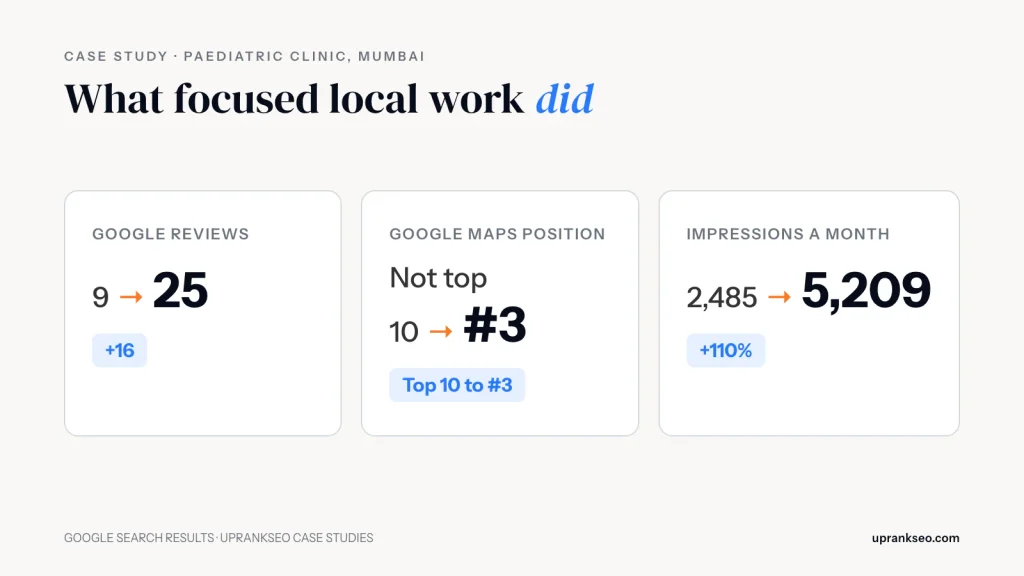
A clinic, not a salon, shows what focused work can do. A paediatric surgeon and paediatric urologist in Santacruz West, Mumbai went from 9 Google reviews to 25 over a few months. Its Google Maps position moved from not in the top 10 to #3, and monthly impressions rose from 2,485 to 5,209. Those are Google results, not AI answers, so read them as a direction.
If your listing needs fixing before you ask for more reviews, our local SEO service covers the Business Profile side. Our AI SEO service covers the pages and mentions that sit around it.
Does an old review still count?
Google doesn’t say how it weighs review age, so there’s no rule to quote. What we can see is how a customer reads a listing. They look at the newest reviews first. If the latest one is months old, the salon can look shut or quiet, whatever the average rating says.
An AI tool summarising your salon has the same problem, because it can only repeat what it finds. A profile whose newest review is old gives it little to work with.
So aim for a flow, not a burst. Ask a few customers each week rather than chasing twenty in a single weekend, and check that the newest review is never weeks old.
Should you reply to every review?
Yes, and it’s quicker than you might think. Google’s help page says replies usually take up to 10 minutes to review, though sometimes a review can take up to 30 days. Your reply appears under the review as a response from the business, not from you personally, and the reviewer is notified when you reply.
Two details matter. Customers can still change their review after reading your reply, and you need a verified profile before you can reply at all.
A reply also shows a checker that someone is at the desk. A few habits make replies useful:
- Thank the customer for the specific thing they mention, such as the colour, the bridal trial or the wait time. Skip the copy-paste line.
- For a bad review, stay calm, say what you’ll change, and offer a phone number or WhatsApp to sort it out in private.
- Never confirm which service a named client had, or what it cost, in public. Keep those details offline.
- Go back and reply to older reviews too, not just the new ones.

Can you offer a discount for a review?
No. This is the habit that gets reviews taken down, and it’s Google’s rule for every business profile rather than a law. Google’s content policy bars businesses from offering incentives, such as payment, discounts, free goods or free services, in exchange for posting any review. Reviews prompted by an incentive are removed. So are reviews written after an incentive to change or remove a negative one.
Salons are tempted by this more than most. A free threading session for a five-star review feels harmless, but it breaks the rule and puts the reviews at risk. Here’s what’s on each side:
| You can | You can’t |
|---|---|
| A loyalty stamp for every visit, whether or not the customer reviews | A discount, free threading or free treatment for a five-star review |
| A review link or QR code shared with every customer | Asking only your happy customers to review |
| Replies to every review, good or bad | A reward for changing or removing a negative review |
| Staff who invite every client | A weekly review target for staff |
Google’s policy also allows businesses to encourage posts that represent a genuine experience, with no incentive attached. That’s the line to stay on.
How do you ask for reviews without breaking the rules?
Make it easy, and make it the same for everyone. Google’s help page says you can share a review request link or QR code. Put the QR code on a card at the desk or on the receipt, and send the link on WhatsApp to clients who’ve agreed to hear from you. Ask at the same point of every visit, not only when someone is delighted.
Staff can help, but don’t pay them per review or set them a target. Google’s policy bars merchants from asking staff to solicit a set number of reviews.
Reviews that name the service and the area do more for a checker than “Great service!” A review that says “balayage in Thane, colour lasted six weeks” gives a search tool more to match. Don’t write reviews for customers or suggest what they should say. That’s our reading of how search works, not a study result.
How do you check whether AI recommends your salon?
Test it once a month. Open ChatGPT, Gemini, Claude and Grok in fresh chats and ask what your customers ask:
- “Which salon in Thane has recent Google reviews for hair colour?”
- “Which bridal makeup salon in Navi Mumbai has reviews from the last few months?”
- “Which salon near Kalyan station replies to its Google reviews?”
- “Which parlour in Mumbai has the highest rating from real customers?”
For each salon named, note the review count, the date of the newest review and whether it replies. Then put your salon next to them. The gap you find is the work to do.
Frequently asked questions
Can I pay a customer to leave a Google review? No. Google’s policy bars offering anything in exchange for a review, and reviews prompted by an incentive are removed. A loyalty stamp for every visit, given whether or not the customer reviews, is a different thing.
How many Google reviews does my salon need? There’s no set number, and Google doesn’t publish one. Its guidance says more reviews and positive ratings can help local ranking, so a steady flow of genuine reviews matters more than a single burst.
Should I reply to a negative review? Yes, briefly and politely. Acknowledge the problem, say what you’ll check, and offer a phone number or WhatsApp to sort it out in private. Never discuss a customer’s treatment in public.
Can I ask for a review on WhatsApp? Yes. Send the same review link or QR code to every client who has agreed to hear from you, and don’t attach an offer. Keep the message the same for every customer.
Can I get a bad review removed? You can flag a review you believe breaks Google’s content policies. Google’s help page says so. You can’t reward a customer for changing or deleting a review, because that’s an incentive Google bans.
Do all AI tools weigh reviews the same way? We couldn’t find a published breakdown for each tool, so be wary of anyone who claims exact weightings. The steps are the same either way: a complete listing, real reviews and replies that other public pages can point to.
Find out what AI says about your salon
We’ll ask ChatGPT, Gemini, Claude and Grok the questions your customers ask, count the reviews each salon near you has, and show you where you stand. It’s free. Request your AI visibility check.