AI tools pick one dentist over another because they can check what they read. Genuine reviews that are recent and replied to, doctor credentials that match on every listing, and treatment pages written in plain words all give an AI something solid to repeat. A smile gallery can help a patient decide, but the National Dental Commission’s advisory of 14 October 2026 flags before-and-after photos and patient testimonials.
This guide covers what AI looks for in a dental clinic, what the advisory means for your gallery and reviews, and how to test the answers every month. If you want the wider picture first, our guide to getting AI to recommend your dental clinic covers the treatment pages and listings side.
Why does AI name one dentist and skip the one down the road?
A parent in Kalyan types, “Which dentist near Kalyan station is good for a child’s first filling?” The AI can’t answer from memory about a clinic that opened last year, so it searches the web. It reads a handful of pages and names the clinics whose details are clearest. Two dentists with the same training can end up with very different results, because one has a clear treatment page, matching listings and recent reviews, and the other has none of these.
BrightLocal studied 800 local searches in ChatGPT, carried out in November 2024. Business websites made up 58% of the sources the tool cited, mentions on other sites made up 27% and directories 15%. The study is American, so read the split as a guide to priorities, not a forecast for your city. Our AI discovery guide explains how those sources fit together.
Do Google reviews change what AI recommends for a dentist?
Yes, though the route isn’t simple. Google says that “more reviews and positive ratings can help your business’s local ranking”, and that positive reviews and helpful replies help a business stand out. BrightLocal found that ChatGPT also draws on review information from Google and Google Maps. It didn’t measure how much, so treat reviews as one signal among several.
The pattern matters more than the star rating. A clinic with a steady flow of recent reviews and a reply to each one looks active. A clinic with eight reviews, the newest from 2023 and no replies looks quiet, even at 4.9 stars. Those are our readings, not Google’s.
Our own work shows the effect on Google, though not on AI. A paediatric surgeon in Santacruz West, Mumbai, went from 9 to 25 Google reviews between June and October 2026. Over the same months, the surgeon’s Google Maps ranking moved from outside the top 10 to #3. Those are Google results, not AI results, so don’t read them as proof of AI visibility. The full case study has the details.
Which credentials should a dentist show online?
AI tools need a name they can match. Show the same details on your website, your Google Business Profile and the directories, and the AI can tie a dentist to a clinic and to the treatments they do. Here’s a starting list.
| What to show | Where it goes | Why it helps |
|---|---|---|
| Full name and degree | Doctor page, Google, directories | Lets the AI tie a name to a clinic |
| Speciality and extra training | Doctor page and treatment pages | Answers “who does aligners?” questions |
| Registration number | Doctor page and every listing | Gives anyone a number they can check. Confirm the format with your adviser |
| Treatments each dentist performs | Treatment pages, with the dentist named | Connects the person to the service |
| Clinic days, hours and languages | Every listing | Answers “open on Sunday?” questions |
The most common mismatch is a dentist who has left but still appears on a directory. One stale profile is enough to make the details disagree, so update every listing when a dentist joins or leaves. If you’d like help checking the listings, our local SEO service covers that work.
Can a dental clinic put a smile gallery on its website?
This is the part to get right first. The National Dental Commission’s Ethics and Dental Registration Board issued an advisory on 14 October 2026 for all registered dental practitioners in India. Medical Dialogues reports that it flags recording consultations and procedures, publishing patient testimonials and before-and-after photographs, and making misleading treatment claims. It also flags inaccurate health information, self-promotion and oversized signboards. Established violations may bring disciplinary action, from a show-cause notice to suspension or removal from the State and National Registers of Dentists.
Careers360 reported in March 2026 that the National Dental Commission replaced the Dental Council of India, with the new framework in effect from 19 March 2026. So the body that can act against your clinic is the NDC, not the old council.
A gallery of before-and-after pairs is the clearest case the advisory covers, so keep those off your site and your social pages. Single photos of a finished result sit in a grey area. The public summary of the advisory doesn’t address them, and the rules on testimonials and misleading claims still apply to any caption you write. Until you have guidance you trust, our advice is to leave patient photos out and describe the work in words. We couldn’t open the NDC’s own text, so check the wording with your legal adviser before you act on any of this.
Instead of a gallery, write a treatment page: what the treatment is, the steps, how long it usually takes, the aftercare and the dentist who performs it. That’s the content an AI tool can quote back to a patient.
What can you say about reviews without breaking the rules?
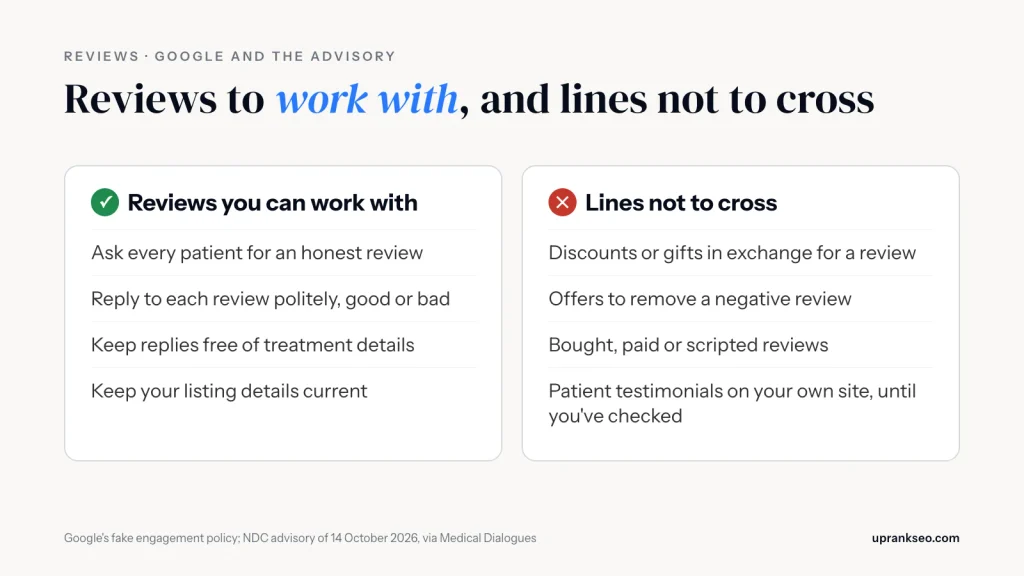
Google’s rules are firmer than the advisory on this point. Its fake engagement policy says that Google does not allow merchants or users to offer incentives, such as payment, discounts or free goods and services, in exchange for posting a review or for changing or removing a negative one. So a free check-up for a five-star review is out, and so is a discount for deleting a bad one.
The advisory is less specific. It flags patient testimonials, but the public summary doesn’t say whether a Google review copied onto your own website counts. Ask your legal adviser before you publish any review on your site.
What you can do is simple. Ask every patient for an honest review, reply to each one politely and keep the reply free of treatment details. Even “sorry the filling felt sore” talks about a patient’s care in public. The clauses the advisory cites cover confidentiality as well as advertising, so keep replies general.
How do you check whether AI recommends your dentist?
Test it once a month. Open ChatGPT, Gemini, Claude and Grok in fresh chats and ask the questions your patients ask:
- “Which dentist in Thane has good, recent reviews for dental implants?”
- “Who can fix a chipped front tooth in Navi Mumbai, and what are the dentist’s qualifications?”
- “Which dentist near Kalyan station is good for a child’s first filling?”
- “Which dentist in Vashi has reviews from the last few months and replies from the clinic?”
Write down which clinics are named, where they appear and which pages each tool cites. If a rival wins on reviews, compare your Google profile with theirs before you change anything else. One test tells you little. A monthly log of dates, tools, questions and names shows whether your changes are moving the answers.
Frequently asked questions
Can a dentist pay to be recommended by ChatGPT or Gemini? No. These tools name clinics based on the pages and listings they read. You can improve those pages and earn mentions, but there’s no paid place in the answer.
Can we show before-and-after photos on our website? The advisory flags before-and-after photographs, so keep them off your website and social pages. For single photos of results, check with your legal adviser before you publish anything.
Can we put Google reviews on our website? Don’t add them without checking first. The advisory flags patient testimonials, and the public summary doesn’t say whether a copied review counts. Ask your legal adviser before you publish any review on your own site.
Which credentials should our website show for each dentist? Full name, degree, speciality, registration number, the treatments the dentist performs, and consultation days and languages. Put the same details on every listing so AI tools can match them.
Does AI read Google reviews for dentists? BrightLocal found that ChatGPT draws on review information from Google and Google Maps, in searches it ran in November 2024. The study didn’t measure how much, so treat reviews as one signal among several.
How many reviews does a clinic need? There’s no set number. Our advice is steady, recent reviews rather than a single burst. A paediatric surgeon in Santacruz West, Mumbai, went from 9 to 25 Google reviews between June and October 2026.
Find out what AI says about your dental clinic
We’ll ask ChatGPT, Gemini, Claude and Grok the questions your patients ask, show you which dentists get named and point out what doesn’t match. It’s free. Request your AI visibility check.