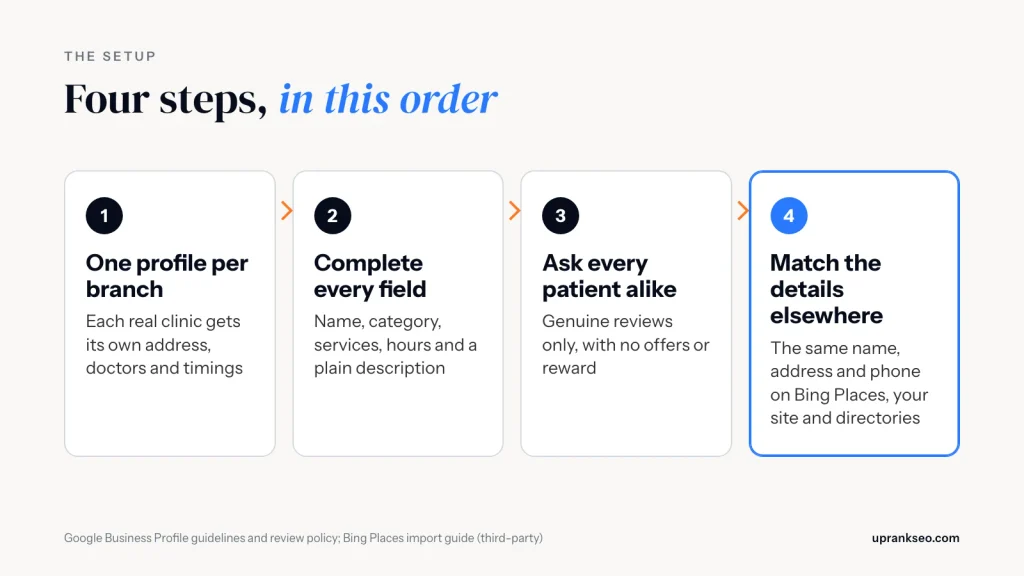
Set up one accurate Google Business Profile for each real clinic, choose a category that matches what you actually do, and list every service and doctor with the right details. Keep the name, address and phone identical everywhere. Earn reviews without offers or pressure, because Google bans incentives. Then match the same details on Bing, since BrightLocal’s November 2024 study found ChatGPT is mostly powered by Bing’s index.
This guide takes the setup in the order we’d do it, whether you have one branch in Thane or a chain across Thane, Kalyan and Navi Mumbai.
What does Google use to rank a clinic on Maps?
Google’s guide says that “local results are mainly based on relevance, distance, and popularity”. Distance is the one factor you can’t change. A patient in Kalyan will always be some way from your clinic in Thane. Relevance is how well your profile matches what someone searched for, so your categories, services and description do that work. Popularity, which Google also calls prominence, is how well known the clinic is, and reviews feed it. Google puts it plainly: “more reviews and positive ratings can help your business’s local ranking”.
Google also says that “businesses with complete and accurate info are more likely to show up in local search results”. You control completeness this week. Reviews take longer to build, so start with the profile.

Which name, category and address should you enter?
Most of the setup is data entry, and most of the mistakes happen there too. This table covers the fields that matter most.
| Field | Enter this | Avoid this |
|---|---|---|
| Business name | The name on your board, your registration and your bills | Keywords such as “best” or “LASIK Thane” added to the name |
| Primary category | The category that describes your core work | A category picked because it gets searched a lot |
| Address | Your real street address, with the floor or wing if patients need it | Extra text in the address line that doesn’t relate to the location |
| Phone and hours | The number patients should ring, with timings for each doctor’s day | An old number left over from a previous branch |
| Description | Two or three plain sentences on what you treat and who it’s for | Claims you can’t back up |
Each row maps to a rule in Google’s business guidelines. Google says that “including unnecessary information in your business name isn’t permitted”. It says to “do not use categories solely as keywords or to describe attributes of your business”. On the address, it says not to “include information in address lines that doesn’t pertain to your business’s physical location”. On the description, it asks you to be upfront and honest about the information you give.
Our local SEO service handles the listing side of this, and our AI SEO work checks the crawler and schema side. The profile itself is a few hours of careful typing, and it’s worth doing slowly.
How many profiles does a multi-branch clinic need?
Google’s rule is one profile per business, and each location gets its own page. The guidelines say: “Do not create more than one page for each location of your business, either in a single account or multiple accounts.” So a clinic with branches in Thane, Kalyan and Navi Mumbai needs one profile per branch, each with its own address, doctors and timings.
That rule cuts both ways. Don’t add a second profile for a branch because the first one looks thin. And if a branch has closed, don’t leave its old profile lying around with the wrong hours. Fix the one you have.
The same logic applies to your website. Each branch needs a page that matches its profile, with the same doctors and timings, so a patient in Mulund sees Mulund details and not the main clinic’s.
What goes into services, doctors and photos?
List each service the way a patient searches for it: cataract surgery, LASIK consultation, paediatric eye check, glaucoma screening. Link each one to its own page on your site. The eye hospital guide makes the same point about procedure pages, and it’s the place to start if you haven’t written them yet.
Add each doctor with their speciality and the days they see patients at that branch. If a doctor works across two branches, each profile should show only the days that apply there.
The NMC’s guidelines of 6 October 2026, as summarised by Medical Dialogues, say a hospital may publish its name, contact details, departments, facilities, emergency services, accreditation status and applicable fees. Stick to that kind of factual detail in the profile. Photos are where many clinics slip. Use real pictures of the front door, the waiting area and the equipment, and keep patients out of the frame. The same rules restrict patient testimonials and before-and-after depictions, and patient consent does not make a prohibited practice permissible.
A doctor’s own photo is a harder call. The same summary says the photograph of a registered medical practitioner can’t be used where it amounts to self-promotion. Whether a profile photo counts is a question for your legal adviser before it goes up.
How do you earn reviews without breaking the rules?
Google’s policy is strict. It says that “Rating Manipulation includes Incentivized or Biased Reviews, which are not allowed and will be removed from Maps”. That covers discounts, free services and any other reward, including a reward for removing a negative review.
Two more rules catch clinics out. Google says merchants may not “selectively solicit positive reviews from customers”, and it bans asking staff to solicit a set number of reviews. What’s allowed is to encourage genuine reviews, with no reward attached.
So put one card at the reception desk, or a QR code on the appointment slip, and give it to everyone. Don’t hand it only to the patients who seemed pleased. The NMC adds its own bar: hospitals and doctors must not “procure, manipulate or cause any third party to procure or manipulate fake followers, likes, reviews, ratings”.
How do Bing and your website fit in?
BrightLocal’s study of 800 local ChatGPT searches, collected in November 2024, reports that ChatGPT is mostly powered by Bing’s Index. The same study says ChatGPT also draws on “review information from Google and Google Maps” when it sources local businesses. So Google reviews help you with ChatGPT too, even though the study doesn’t say how often that happens.
Bing Places is the next step. One walkthrough by Dalton Luka describes importing a Google Business Profile into Bing Places, with an optional sync at regular intervals. It’s a third-party guide, so check each step against what Bing shows you when you sign in.
Google’s own guidance on AI features is shorter. A page must be “indexed and eligible to be shown in Google Search with a snippet”, and there are “no additional technical requirements”. Its list of SEO practices also asks site owners to keep their Business Profile information up to date. For the wider picture, our guide on how AI tools decide covers the crawler side.
What does a real result look like?
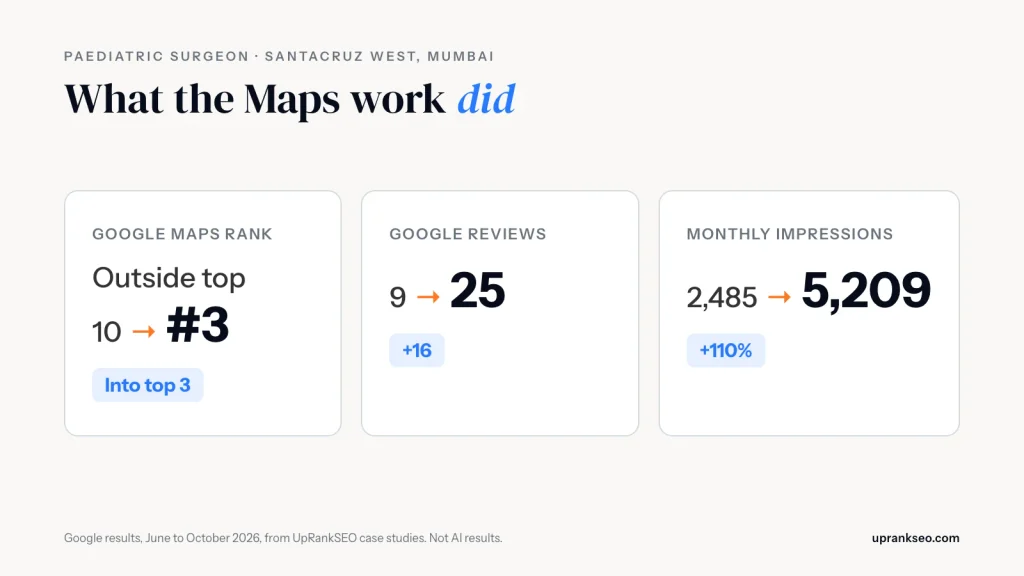
One of our clients is a paediatric surgeon in Santacruz West, Mumbai. It isn’t an eye practice, but the numbers show what the Maps side of a profile can do. Between June and October 2026, Google Maps moved from outside the top 10 to #3, and Google reviews rose from 9 to 25. Monthly impressions went from 2,485 to 5,209 over the same period. These are Google results, not AI results, so read them as evidence of local visibility.
How do you check whether AI recommends your clinic?
Test it once a month. Open ChatGPT, Gemini, Claude and Grok in fresh chats and ask what your patients ask:
- “Which eye clinic near Thane station is open on Sunday?”
- “Which eye clinic in Kalyan does cataract surgery and lists its doctors?”
- “Who does paediatric eye checks in Navi Mumbai, and what are the timings?”
- “Which eye clinic near Ghodbunder Road takes cashless insurance?”
Note whether your clinic is named and which listing each tool points to. If a competitor gets named instead, put the two profiles side by side and compare categories, services, hours and review counts.
Frequently asked questions
Do we still need a Google Business Profile if we have a good website? Yes. Google’s guidance treats keeping Business Profile information up to date as part of search work, and the profile is what patients see on Maps. Your website does a different job, and the two should say the same things.
Can we add “best” or a treatment name to the clinic name to rank higher? No. Google doesn’t permit unnecessary information in a business name, and the NMC allows “best” claims only when they can be objectively verified. Use the name on your registration and let the services list do the describing.
Can we give a discount or a free check-up to patients who leave a review? No. Google bans offering incentives in exchange for posting any review, and that includes discounts and free services. Ask every patient the same way, with no reward attached.
Should a doctor’s photo go on the Google profile? Check with your legal adviser first. The NMC guidelines, as summarised in the press, say a registered medical practitioner’s photograph can’t be used where it amounts to self-promotion, and whether a profile photo counts is a judgement call.
Does ChatGPT read Google reviews? According to BrightLocal’s study, it can. The study says ChatGPT sources local business information using review information from Google and Google Maps, so reviews help there too.
Find out what AI says about your clinic
We’ll ask ChatGPT, Gemini, Claude and Grok the questions your patients ask, and check your Google profile against what Maps and the AI tools can read. You’ll get a free list of the fixes that come first. Request your AI visibility check.