

Someone in Thane who types “fee-only financial planner near me” now gets two lists: a map of nearby names and, often, a shortlist from an AI tool. To appear in both, your office details, your fee structure and your pages must say the same things. Google Business Profile puts you on the map, your website gives AI tools something to read, and SEBI’s advertising rules decide what you can’t promise.
This guide covers how the map and the AI tools choose, what your pages and listings should contain, and where SEBI’s new advertising code draws the line. Most of it is ordinary local SEO done carefully. The compliance part is the one you can’t skip.
What does “fee-only” mean for a planner in India?
Fee-only is a phrase people use loosely, so use it with care. A SEBI-registered investment adviser is paid for advice. Selling products and earning from them is distribution, and SEBI’s rules keep the two apart. A 2020 review of the adviser rules by IndiaCorpLaw says a single client can’t take both advisory and distribution services from the same entity. Check with your compliance adviser that this still holds for your firm before you describe it as fee-only.
If you’re a registered adviser, check your own listing before a client does. The Someone in Thane who types “fee-only financial planner near me” now gets two lists: a map of nearby names and, often, a shortlist from an AI tool. To appear in both, your office details, your fee structure and your pages must say the same things. Google Business Profile puts you on the map, your website gives AI tools something to read, and SEBI’s advertising rules decide what you can’t promise.
This guide covers how the map and the AI tools choose, what your pages and listings should contain, and where SEBI’s new advertising code draws the line. Most of it is ordinary local SEO done carefully. The compliance part is the one you can’t skip.
What does “fee-only” mean for a planner in India?
Fee-only is a phrase people use loosely, so use it with care. A SEBI-registered investment adviser is paid for advice. Selling products and earning from them is distribution, and SEBI’s rules keep the two apart. A 2020 review of the adviser rules by IndiaCorpLaw says a single client can’t take both advisory and distribution services from the same entity. Check with your compliance adviser that this still holds for your firm before you describe it as fee-only.
If you’re a registered adviser, check your own listing before a client does. The SEBI website has an intermediaries section where you can look up your registration, and your site should show the number exactly as it appears there.
How do clients search for a planner near them?
Most of these searches carry a place name: “financial planner Thane”, “retirement planning Navi Mumbai”, “SIP advisor Powai”, or simply “fee-only planner near me”. Google says local results are “mainly based on relevance, distance, and popularity”. In plain terms, relevance is how well your profile and pages match what was typed. Distance is how far your office is from the person searching. Popularity, which Google also calls prominence, is how well known you are, and reviews and mentions help build it.
Distance is the factor planners overlook. If your office is in Vashi and most of your clients live in Powai, a search from Powai will favour a planner nearer to it. You can’t move your office, but you can make your service area clear, with pages that explain how meetings and reviews work for clients in other suburbs. What doesn’t help is a separate page for every suburb you can name. Thin location pages add little, for people or for AI tools.

How do ChatGPT, Gemini and Claude choose which planner to name?
The pattern is the one we describe for any local business. The tool searches, reads a handful of pages, and names the advisers those pages describe clearly. ChatGPT runs its own crawler, OAI-SearchBot, which OpenAI says “is used to surface websites in search results in ChatGPT’s search features”. Sites that block it “will not be shown in ChatGPT search answers”, so check your robots.txt before anything else.
Gemini and Google’s AI Overviews sit on top of Google Search. Google says there are “no additional technical requirements” for its AI features, which means good local SEO already covers most of what Google’s AI needs.
The tools don’t agree with each other. In an October 2026 test by Ryan Doser, four AI assistants were asked the same local questions, and their first picks matched in only 6 of 72 head-to-head comparisons. That test covered home-service businesses in two US cities, not financial advisers, so read the numbers as a warning rather than a benchmark. We found no published test of financial advisers specifically. Check several tools each month, not one. For the wider mechanics, our guide on how AI tools decide which business to recommend goes further, and our AI SEO service covers the work itself.
What should a planner’s website say that an AI tool can quote?
Vague pages get skipped. These are the things worth publishing, each with a sentence or two of plain detail.
| What the AI checks | What you should publish |
|---|---|
| Do you offer the service the client asked about? | One page each for retirement planning, children’s education goals and portfolio reviews, with what happens at each step |
| How are you paid? | A fee page with your fee model, what a client pays, how often, and what it covers |
| Who is behind the advice? | Names, qualifications, years of practice and your SEBI registration number on a team page |
| Is the office where the listing says? | The same address, phone and hours on your site, Google and every directory |
| Do other people vouch for you? | Genuine client reviews, local news mentions, association or event listings |
The fee page does the most work, and most planners either skip it or hide it behind a call-back form. Write it the way a client would say it: what the fee is, how often it’s billed, what it covers and what it doesn’t. Only publish fees you can keep to. A line like “lowest fee in Mumbai” adds nothing, and it’s the sort of unsupported claim the SEBI code warns about, covered below.
Which listings and reviews matter most?
Start with your Google Business Profile. Use your real office address, the closest financial category Google offers for your work, your hours, and photos of the office you actually use. Google says “businesses with complete and accurate info are more likely to show up in local search results”. Our local SEO service covers the rest of the listing work if you’d rather hand it over.
Then check that the same details sit on your website, on Bing Places and on any directory where you’re listed. An old phone number on one listing makes a tool hesitate, and a planner who moved offices two years ago often has the old address somewhere online.
Reviews help as well. Google says “more reviews and positive ratings can help your business’s local ranking”. Ask clients for honest reviews after a portfolio review, reply to every one, and never offer a fee discount or a gift in return. Before you show reviews on your website or in an ad, ask your compliance adviser. The SEBI code discussed below bans testimonials in advertisements once it takes effect.
What can’t a planner promise or post?
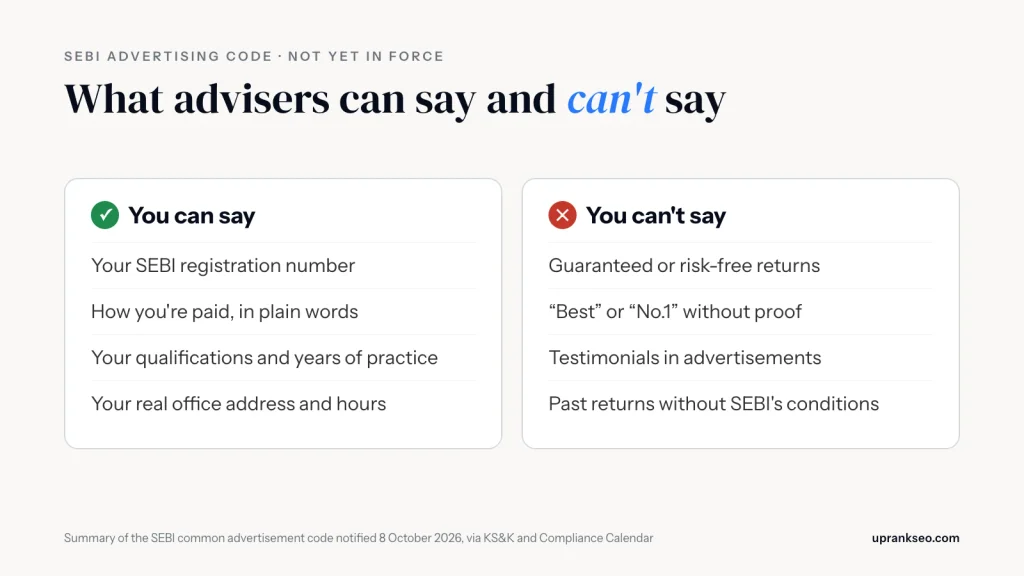
SEBI has notified a common advertising code for regulated intermediaries, and investment advisers are covered. It was published in the Gazette on 9 October 2026 and takes effect 180 days later, which lands around April 2027. Check the exact date before you rely on it. Until then, your existing SEBI rules still apply. Two summaries of the notified text, from KS&K and Compliance Calendar, point to these limits:
- No promise, or hint, of guaranteed, risk-free or fixed returns.
- No misleading or exaggerated claims. “Best” or “No.1” claims you can’t back up fall under this.
- No testimonials in advertisements.
- Past performance only in the way SEBI specifies, and never implying that it will repeat.
The registration number has to appear in advertisements too, along with the disclaimers SEBI prescribes. The summaries also say ratings and rankings are allowed only when a designated rating agency assigns them, so don’t publish a ranking of your own. None of this stops you being found. It stops you claiming more than you can show.
What does local search look like for a regulated service?
We don’t have a case study for financial advisers yet, and we won’t stretch one to fit. The closest we can show is a RERA-registered consultancy in Hiranandani Estate, Thane. It’s another regulated, trust-based service where people search “near me” and compare before they call.
Within three months (July to October 2026), the consultancy had 19 of 19 keywords on page one, and 17 in the top five, up from 3. Monthly impressions went from 669 to 1,359, and it received 47 Google Maps calls a month. “Real estate agent near me” moved from second place to first.
These are Google results, not AI results. They matter because AI tools read the pages that rank well, so a planner who wins the same local treatment ends up in front of more of the sources those tools draw on.
How do you check whether AI recommends your practice?
Test it once a month. Open ChatGPT, Gemini, Claude and Grok in fresh chats and ask what your clients ask:
- “Who is a fee-only financial planner in Thane?”
- “Which SEBI-registered adviser in Navi Mumbai charges a fixed fee for retirement planning?”
- “Who can help a salaried couple in Powai plan for their child’s college fees?”
- “Is there a fee-only planner in the western suburbs who doesn’t sell insurance or funds?”
Note whether you’re named, where you appear, and which pages each tool cites. Those cited pages show you what to fix first.
Frequently asked questions
Can I pay ChatGPT or Gemini to recommend my practice? No. These tools name advisers based on the pages and listings they read. You can improve those, but there’s no paid place in the answer.
Can I call my practice fee-only? Only if the phrase describes your firm exactly. Check how your registration covers your work, and ask your compliance adviser about any commission or distribution income before you use the word.
Do I need to show my SEBI registration number online? Show it on your website now. The summaries we checked say advertisements will need it once the new code takes effect, and it’s easier to add it today than to chase every page in April.
Can I put client reviews on my website? That’s a question for your compliance adviser. The new code bans testimonials in advertisements, and whether a review you show on your site counts as one depends on how you use it. Don’t pay for reviews or offer rewards for them.
Why does AI name an adviser with fewer years in practice? Because that adviser’s pages describe their work clearly for that area. Years of practice help only when they’re written down on a page a tool can read, next to qualifications and fees.
How long before my practice starts showing up? Google rankings take time to move, and AI answers built from live search can change once your pages are indexed and ranking. Set a monthly check rather than a deadline.
Find out what AI says about your practice
We’ll ask ChatGPT, Gemini, Claude and Grok the questions your clients ask, show you who gets named, and point out what’s holding you back. It’s free. Request your AI visibility check.